Pearson+ LogoPearson+ Logo
Ch. 11 - DNA Replication and Recombination
Klug - Concepts of Genetics  12th Edition
Klug12th EditionConcepts of Genetics ISBN: 9780135564776Not the one you use?Change textbook
Chapter 11, Problem 14

Distinguish between
(a) unidirectional and bidirectional synthesis, and
(b) continuous and discontinuous synthesis of DNA.

Verified step by step guidance
1
Step 1: Define unidirectional synthesis of DNA as the process where DNA replication proceeds in only one direction from the origin of replication, meaning the replication fork moves in a single direction along the DNA strand.
Step 2: Define bidirectional synthesis of DNA as the process where replication starts at a specific origin and proceeds in two opposite directions simultaneously, creating two replication forks moving away from the origin.
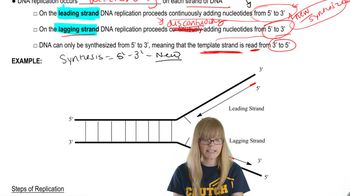
Step 3: Explain continuous synthesis of DNA as the process occurring on the leading strand, where DNA polymerase synthesizes a new strand continuously in the 5' to 3' direction as the replication fork opens.
Step 4: Explain discontinuous synthesis of DNA as the process occurring on the lagging strand, where DNA polymerase synthesizes short fragments called Okazaki fragments in the 5' to 3' direction, which are later joined together to form a continuous strand.
Step 5: Summarize the differences by highlighting that unidirectional vs. bidirectional synthesis refers to the directionality of replication forks, while continuous vs. discontinuous synthesis refers to the mode of strand elongation on the leading and lagging strands, respectively.

Verified video answer for a similar problem:

This video solution was recommended by our tutors as helpful for the problem above.
Video duration:
2m
Was this helpful?

Key Concepts

Here are the essential concepts you must grasp in order to answer the question correctly.

Unidirectional vs. Bidirectional DNA Synthesis

Unidirectional DNA synthesis occurs when replication proceeds in only one direction from the origin, producing a single replication fork. In contrast, bidirectional synthesis involves two replication forks moving in opposite directions from the origin, allowing faster and more efficient DNA replication.
Recommended video:
Guided course
05:02
Directionality

Continuous DNA Synthesis

Continuous DNA synthesis refers to the process where the new DNA strand is synthesized smoothly and continuously in the 5' to 3' direction on the leading strand, following the replication fork movement without interruption.
Recommended video:
Guided course
02:43
Translesion Synthesis

Discontinuous DNA Synthesis

Discontinuous DNA synthesis occurs on the lagging strand, where DNA is synthesized in short fragments called Okazaki fragments. These fragments are later joined together by DNA ligase to form a continuous strand, due to the antiparallel nature of DNA and the 5' to 3' synthesis direction.
Recommended video:
Guided course
02:43
Translesion Synthesis