Pearson+ LogoPearson+ Logo
Ch. 13 - The Genetic Code and Transcription
Klug - Concepts of Genetics  12th Edition
Klug12th EditionConcepts of Genetics ISBN: 9780135564776Not the one you use?Change textbook
Chapter 13, Problem 29e

Shown here are the amino acid sequences of the wild-type and three mutant forms of a short protein.
___________________________________________________
Wild-type: Met-Trp-Tyr-Arg-Gly-Ser-Pro-Thr
Mutant 1: Met-Trp
Mutant 2: Met-Trp-His-Arg-Gly-Ser-Pro-Thr
Mutant 3: Met -Cys-Ile-Val-Val-Val-Gln-His
___________________________________________________
Use this information to answer the following questions:
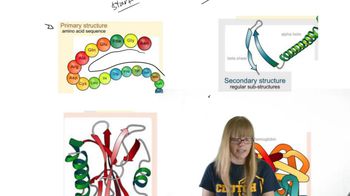
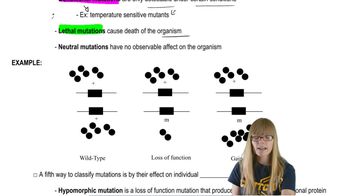
Another mutation (mutant 4) is isolated. Its amino acid sequence is unchanged from the wild type, but the mutant cells produce abnormally low amounts of the wild-type proteins. As specifically as you can, predict where this mutation exists in the gene.

Verified step by step guidance
1
Understand that the amino acid sequence of mutant 4 is identical to the wild-type protein, indicating that the mutation does not change the protein's primary structure.
Since the protein sequence is unchanged but the amount of protein produced is abnormally low, consider mutations that affect gene expression rather than protein coding, such as mutations in regulatory regions.
Identify key regulatory regions in the gene that control transcription and translation, including the promoter, enhancer, and possibly the 5' untranslated region (5' UTR) or sequences affecting mRNA stability.
Predict that the mutation likely exists in the promoter or other regulatory elements upstream of the coding sequence, which would reduce transcription efficiency and thus lower protein production without altering the amino acid sequence.
Conclude that the mutation is not in the coding region but in a regulatory region of the gene that controls the amount of protein synthesized.

Verified video answer for a similar problem:

This video solution was recommended by our tutors as helpful for the problem above.
Video duration:
2m
Was this helpful?

Key Concepts

Here are the essential concepts you must grasp in order to answer the question correctly.

Gene Expression and Protein Synthesis

Gene expression involves transcribing DNA into mRNA and translating mRNA into a protein sequence. Mutations can affect protein quantity or quality by altering transcription, mRNA stability, or translation efficiency, even if the amino acid sequence remains unchanged.
Recommended video:

Types of Mutations Affecting Protein Levels

Mutations outside the coding region, such as in promoters, enhancers, or regulatory sequences, can reduce protein production without changing the amino acid sequence. These regulatory mutations impact transcription initiation or mRNA processing, leading to lower protein amounts.
Recommended video:
Guided course
10:48
Mutations and Phenotypes

Relationship Between DNA Sequence and Protein Sequence

The amino acid sequence is determined by the coding DNA sequence, but mutations in non-coding regions or synonymous codons can affect gene expression levels. Thus, unchanged protein sequences can still result from mutations that alter gene regulation rather than protein structure.
Recommended video:
Guided course
08:55
Sequencing Overview
Related Practice
Textbook Question

Shown here are the amino acid sequences of the wild-type and three mutant forms of a short protein.

___________________________________________________

Wild-type: Met-Trp-Tyr-Arg-Gly-Ser-Pro-Thr

Mutant 1: Met-Trp

Mutant 2: Met-Trp-His-Arg-Gly-Ser-Pro-Thr

Mutant 3: Met-Cys-Ile-Val-Val-Val-Gln-Hi

___________________________________________________

Use this information to answer the following questions:

For each mutant protein, determine the specific ribonucleotide change that led to its synthesis.

478
views
Textbook Question

Shown here are the amino acid sequences of the wild-type and three mutant forms of a short protein.

__________________________________________________

Wild-type: Met-Trp-Tyr-Arg-Gly-Ser-Pro-Thr

Mutant 1: Met-Trp

Mutant 2: Met-Trp-His-Arg-Gly-Ser-Pro-Thr

Mutant 3: Met -Cys-Ile-Val-Val-Val-Gln-His

______________________________________________

Use this information to answer the following questions:

The wild-type RNA consists of nine triplets. What is the role of the ninth triplet?

500
views
Textbook Question

Shown here are the amino acid sequences of the wild-type and three mutant forms of a short protein.

___________________________________________________

Wild-type: Met-Trp-Tyr-Arg-Gly-Ser-Pro-Thr

Mutant 1: Met-Trp

Mutant 2: Met-Trp-His-Arg-Gly-Ser-Pro-Thr

Mutant 3: Met-Cys-Ile-Val-Val-Val-Gln-Hi

___________________________________________________

Use this information to answer the following questions:

Of the first eight wild-type triplets, which, if any, can you determine specifically from an analysis of the mutant proteins? In each case, explain why or why not.

566
views
Textbook Question

The genetic code is degenerate. Amino acids are encoded by either 1, 2, 3, 4, or 6 triplet codons. An interesting question is whether the number of triplet codes for a given amino acid is in any way correlated with the frequency with which that amino acid appears in proteins. That is, is the genetic code optimized for its intended use? Some approximations of the frequency of appearance of nine amino acids in proteins in E. coli are given in the following:

Determine how many triplets encode each amino acid.

809
views
Textbook Question

The genetic code is degenerate. Amino acids are encoded by either 1, 2, 3, 4, or 6 triplet codons. An interesting question is whether the number of triplet codes for a given amino acid is in any way correlated with the frequency with which that amino acid appears in proteins. That is, is the genetic code optimized for its intended use? Some approximations of the frequency of appearance of nine amino acids in proteins in E. coli are given in the following:

Devise a way to graphically compare the two sets of information (data).

550
views
Textbook Question

The genetic code is degenerate. Amino acids are encoded by either 1, 2, 3, 4, or 6 triplet codons. An interesting question is whether the number of triplet codes for a given amino acid is in any way correlated with the frequency with which that amino acid appears in proteins. That is, is the genetic code optimized for its intended use? Some approximations of the frequency of appearance of nine amino acids in proteins in E. coli are given in the following:

Analyze your data to determine what, if any, correlations can be drawn between the relative frequency of amino acids making up proteins and the number of codons for each. Write a paragraph that states your specific and general conclusions.

713
views