Pearson+ LogoPearson+ Logo
Ch. 13 - The Genetic Code and Transcription
Klug - Concepts of Genetics  12th Edition
Klug12th EditionConcepts of Genetics ISBN: 9780135564776Not the one you use?Change textbook
Chapter 13, Problem 30a

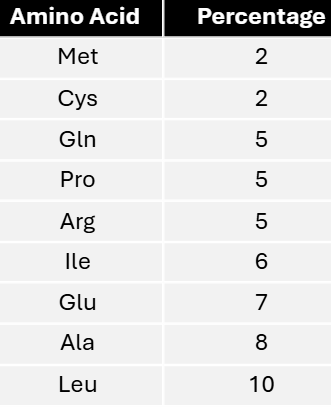
The genetic code is degenerate. Amino acids are encoded by either 1, 2, 3, 4, or 6 triplet codons. An interesting question is whether the number of triplet codes for a given amino acid is in any way correlated with the frequency with which that amino acid appears in proteins. That is, is the genetic code optimized for its intended use? Some approximations of the frequency of appearance of nine amino acids in proteins in E. coli are given in the following:

Determine how many triplets encode each amino acid.

Verified step by step guidance
1
Step 1: Understand the problem. The goal is to determine the number of triplet codons that encode each amino acid listed in the table. The genetic code is degenerate, meaning multiple codons can encode the same amino acid.
Step 2: Recall the genetic code table. Each amino acid is encoded by a specific number of codons. For example, Methionine (Met) is encoded by 1 codon, while Leucine (Leu) is encoded by 6 codons. Use the genetic code table to find the number of codons for each amino acid.
Step 3: Match each amino acid in the given list (Met, Cys, Gln, Pro, Arg, Ile, Glu, Ala, Leu) with its corresponding number of codons from the genetic code table. For example, Methionine (Met) is encoded by 1 codon, and Leucine (Leu) is encoded by 6 codons.
Step 4: Create a list or table that pairs each amino acid with its respective number of codons. For example: Met - 1 codon, Cys - 2 codons, Gln - 2 codons, etc.
Step 5: Analyze the relationship between the frequency of appearance of each amino acid (given as percentages) and the number of codons encoding it. Consider whether amino acids with higher frequencies tend to have more codons, which could suggest optimization in the genetic code.

Verified video answer for a similar problem:

This video solution was recommended by our tutors as helpful for the problem above.
Video duration:
1m
Was this helpful?

Key Concepts

Here are the essential concepts you must grasp in order to answer the question correctly.

Degeneracy of the Genetic Code

The genetic code is described as degenerate because most amino acids are encoded by more than one codon. This redundancy allows for some mutations in the DNA sequence to occur without altering the resulting protein, providing a buffer against potential harmful effects of genetic changes.
Recommended video:
Guided course
11:43
The Genetic Code

Codon Usage and Amino Acid Frequency

Codon usage refers to the frequency with which different codons are used to encode the same amino acid in a given organism. The correlation between the number of codons for an amino acid and its frequency in proteins can indicate whether the genetic code is optimized for efficient protein synthesis in that organism.
Recommended video:
Guided course
03:03
New Alleles and Migration

Triplet Codons

Triplet codons are sequences of three nucleotides in mRNA that specify a particular amino acid during protein synthesis. Each amino acid can be represented by one or more triplet codons, and understanding how many triplets correspond to each amino acid is crucial for analyzing the efficiency and adaptability of the genetic code.
Recommended video:
Guided course
11:43
The Genetic Code
Related Practice
Textbook Question

Shown here are the amino acid sequences of the wild-type and three mutant forms of a short protein.

__________________________________________________

Wild-type: Met-Trp-Tyr-Arg-Gly-Ser-Pro-Thr

Mutant 1: Met-Trp

Mutant 2: Met-Trp-His-Arg-Gly-Ser-Pro-Thr

Mutant 3: Met -Cys-Ile-Val-Val-Val-Gln-His

______________________________________________

Use this information to answer the following questions:

The wild-type RNA consists of nine triplets. What is the role of the ninth triplet?

500
views
Textbook Question

Shown here are the amino acid sequences of the wild-type and three mutant forms of a short protein.

___________________________________________________

Wild-type: Met-Trp-Tyr-Arg-Gly-Ser-Pro-Thr

Mutant 1: Met-Trp

Mutant 2: Met-Trp-His-Arg-Gly-Ser-Pro-Thr

Mutant 3: Met-Cys-Ile-Val-Val-Val-Gln-Hi

___________________________________________________

Use this information to answer the following questions:

Of the first eight wild-type triplets, which, if any, can you determine specifically from an analysis of the mutant proteins? In each case, explain why or why not.

566
views
Textbook Question

Shown here are the amino acid sequences of the wild-type and three mutant forms of a short protein.

___________________________________________________

Wild-type: Met-Trp-Tyr-Arg-Gly-Ser-Pro-Thr

Mutant 1: Met-Trp

Mutant 2: Met-Trp-His-Arg-Gly-Ser-Pro-Thr

Mutant 3: Met -Cys-Ile-Val-Val-Val-Gln-His

___________________________________________________

Use this information to answer the following questions:

Another mutation (mutant 4) is isolated. Its amino acid sequence is unchanged from the wild type, but the mutant cells produce abnormally low amounts of the wild-type proteins. As specifically as you can, predict where this mutation exists in the gene.

1177
views
Textbook Question

The genetic code is degenerate. Amino acids are encoded by either 1, 2, 3, 4, or 6 triplet codons. An interesting question is whether the number of triplet codes for a given amino acid is in any way correlated with the frequency with which that amino acid appears in proteins. That is, is the genetic code optimized for its intended use? Some approximations of the frequency of appearance of nine amino acids in proteins in E. coli are given in the following:

Devise a way to graphically compare the two sets of information (data).

550
views
Textbook Question

The genetic code is degenerate. Amino acids are encoded by either 1, 2, 3, 4, or 6 triplet codons. An interesting question is whether the number of triplet codes for a given amino acid is in any way correlated with the frequency with which that amino acid appears in proteins. That is, is the genetic code optimized for its intended use? Some approximations of the frequency of appearance of nine amino acids in proteins in E. coli are given in the following:

Analyze your data to determine what, if any, correlations can be drawn between the relative frequency of amino acids making up proteins and the number of codons for each. Write a paragraph that states your specific and general conclusions.

713
views
Textbook Question

The genetic code is degenerate. Amino acids are encoded by either 1, 2, 3, 4, or 6 triplet codons. An interesting question is whether the number of triplet codes for a given amino acid is in any way correlated with the frequency with which that amino acid appears in proteins. That is, is the genetic code optimized for its intended use? Some approximations of the frequency of appearance of nine amino acids in proteins in E. coli are given in the following:

How would you proceed with your analysis if you wanted to pursue this problem further?

742
views