Pearson+ LogoPearson+ Logo
Ch. 14 - Translation and Proteins
Klug - Concepts of Genetics  12th Edition
Klug12th EditionConcepts of Genetics ISBN: 9780135564776Not the one you use?Change textbook
Chapter 14, Problem 28

List three different types of posttranslational modifications that may happen to a protein and the significance of each in the context of protein function.

Verified step by step guidance
1
Identify what posttranslational modifications (PTMs) are: chemical changes that occur to a protein after it has been synthesized (translated) from mRNA, which can alter the protein's function, localization, stability, or interactions.
List the first type of PTM, such as phosphorylation, and explain that it involves the addition of a phosphate group (PO₄³⁻) typically to serine, threonine, or tyrosine residues, which can regulate protein activity, signaling pathways, and interactions.
List the second type of PTM, such as glycosylation, which is the attachment of carbohydrate groups to specific amino acids, important for protein folding, stability, and cell-cell recognition.
List the third type of PTM, such as ubiquitination, where ubiquitin proteins are attached to lysine residues, marking the protein for degradation by the proteasome or altering its cellular location or activity.
For each PTM, emphasize its significance in modulating protein function dynamically, allowing cells to respond to environmental signals and maintain homeostasis.

Verified video answer for a similar problem:

This video solution was recommended by our tutors as helpful for the problem above.
Video duration:
57s
Was this helpful?

Key Concepts

Here are the essential concepts you must grasp in order to answer the question correctly.

Posttranslational Modifications (PTMs)

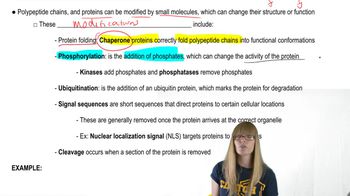
PTMs are chemical changes made to a protein after its synthesis, altering its properties and functions. These modifications regulate protein activity, localization, stability, and interactions, enabling dynamic control of cellular processes.
Recommended video:
Guided course
04:30
Post Translational Modifications

Phosphorylation

Phosphorylation involves adding a phosphate group to amino acids like serine, threonine, or tyrosine. This modification often acts as an on/off switch for protein activity, playing a critical role in signaling pathways and cellular regulation.
Recommended video:
Guided course
04:30
Post Translational Modifications

Glycosylation

Glycosylation is the attachment of sugar molecules to proteins, influencing folding, stability, and cell-cell recognition. It is essential for protein trafficking and immune responses, especially in membrane and secreted proteins.