Pearson+ LogoPearson+ Logo
Ch. 14 - Translation and Proteins
Klug - Concepts of Genetics  12th Edition
Klug12th EditionConcepts of Genetics ISBN: 9780135564776Not the one you use?Change textbook
Chapter 14, Problem 29

Why are misfolded proteins a potential problem for the eukaryotic cell, and how do cells combat the accumulation of misfolded proteins?

Verified step by step guidance
1
Misfolded proteins can disrupt cellular function by forming aggregates that interfere with normal cellular processes.
These aggregates can be toxic, leading to cell damage or death, and are associated with diseases such as Alzheimer's and Parkinson's.
Eukaryotic cells have quality control mechanisms in the endoplasmic reticulum (ER) to ensure proper protein folding.
The unfolded protein response (UPR) is activated when misfolded proteins accumulate, leading to increased production of molecular chaperones that assist in protein folding.
If misfolded proteins cannot be refolded, they are targeted for degradation by the ubiquitin-proteasome system, preventing their accumulation.

Verified video answer for a similar problem:

This video solution was recommended by our tutors as helpful for the problem above.
Video duration:
1m
Was this helpful?

Key Concepts

Here are the essential concepts you must grasp in order to answer the question correctly.

Protein Folding

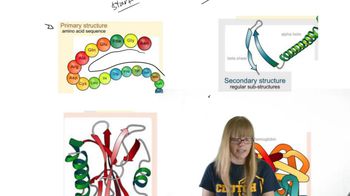
Protein folding is the process by which a polypeptide chain acquires its functional three-dimensional structure. Proper folding is crucial for protein functionality, as misfolded proteins can lead to loss of function or gain of toxic properties. This process is assisted by molecular chaperones, which help proteins fold correctly and prevent aggregation.
Recommended video:

Proteostasis

Proteostasis refers to the maintenance of cellular protein balance, ensuring that proteins are correctly folded, functional, and degraded when necessary. Cells utilize various mechanisms, including chaperones and proteolytic systems, to manage protein quality control. Disruption of proteostasis can lead to the accumulation of misfolded proteins, which is detrimental to cell health.

Cellular Stress Responses

Cellular stress responses are adaptive mechanisms that cells activate in response to stressors, such as the accumulation of misfolded proteins. These responses include the unfolded protein response (UPR), which enhances the production of chaperones and increases degradation pathways to clear misfolded proteins. Effective stress responses are vital for cell survival and function under adverse conditions.
Recommended video:
Guided course
02:43
Translesion Synthesis