HbS results in anemia and resistance to malaria, whereas in those with HbA, the parasite Plasmodium falciparum is able to invade red blood cells and cause malaria. Predict whether those with HbC are likely to be anemic and whether they would be resistant to malaria.
Ch. 14 - Translation and Proteins

Chapter 14, Problem 25
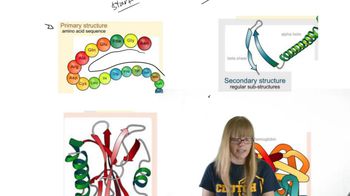
What are the two common types of protein secondary structure, and how do they differ?
Verified step by step guidance1
Identify the two common types of protein secondary structures: alpha helices and beta sheets.
Understand that an alpha helix is a right-handed coil where each amino acid corresponds to a 100-degree turn in the helix, and the structure is stabilized by hydrogen bonds between the carbonyl oxygen of one amino acid and the amide hydrogen of another four residues away.
Recognize that beta sheets consist of beta strands connected laterally by at least two or three backbone hydrogen bonds, forming a sheet-like structure. The strands can be parallel or antiparallel.
Note the difference in hydrogen bonding: in alpha helices, hydrogen bonds occur within a single strand, while in beta sheets, they occur between different strands.
Consider the functional implications: alpha helices often form structural components of proteins, while beta sheets can provide strength and stability, often found in the core of proteins.

Verified video answer for a similar problem:
This video solution was recommended by our tutors as helpful for the problem above.
Video duration:
53sWas this helpful?
Key Concepts
Here are the essential concepts you must grasp in order to answer the question correctly.
Protein Secondary Structure
Protein secondary structure refers to the local folded structures that form within a polypeptide due to hydrogen bonding between the backbone atoms. The two most common types are alpha helices and beta sheets, which contribute to the overall stability and functionality of proteins.
Recommended video:
Guided course
Proteins
Alpha Helix
An alpha helix is a right-handed coiled structure where each turn of the helix is stabilized by hydrogen bonds between the carbonyl oxygen of one amino acid and the amide hydrogen of another, four residues down the chain. This structure is characterized by its helical shape and is commonly found in many proteins.
Recommended video:
Guided course
Review of Regulation
Beta Sheet
Beta sheets are formed by linking two or more beta strands through hydrogen bonds, creating a sheet-like structure. These strands can be parallel or antiparallel, depending on the direction of the polypeptide chains, and they provide significant tensile strength to proteins, often found in fibrous proteins.
Recommended video:
Guided course
Proteins
Related Practice
Textbook Question
801
views
Textbook Question
Several amino acid substitutions in the α and β chains of human hemoglobin are shown in the following table.
Using the code table, determine how many of them can occur as a result of a single-nucleotide change.
759
views
Textbook Question
Define and compare the four levels of protein organization.
755
views
Textbook Question
How do covalent disulfide bonds, hydrogen bonds with water, and hydrophobic interactions all contribute to a protein's tertiary structure?
784
views
Textbook Question
List as many different categories of protein functions as you can. Wherever possible, give an example of each category.
684
views
Textbook Question
List three different types of posttranslational modifications that may happen to a protein and the significance of each in the context of protein function.
441
views