Pearson+ LogoPearson+ Logo
Ch. 16 - Regulation of Gene Expression in Bacteria
Klug - Concepts of Genetics  12th Edition
Klug12th EditionConcepts of Genetics ISBN: 9780135564776Not the one you use?Change textbook
Chapter 16, Problem 15

The creation of milk products such as cheeses and yogurts is dependent on the conversion by various anaerobic bacteria, including several Lactobacillus species, of lactose to glucose and galactose, ultimately producing lactic acid. These conversions are dependent on both permease and β-galactosidase as part of the lac operon. After selection for rapid fermentation for the production of yogurt, one Lactobacillus subspecies lost its ability to regulate lac operon expression [Lapierre, L., et al. (2002). J. Bacteriol. 184:928–935]. Would you consider it likely that in this subspecies the lac operon is on or off? What genetic events would likely contribute to the loss of regulation as described above?

Verified step by step guidance
1
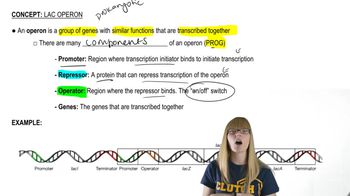
Understand the lac operon: The lac operon is a set of genes in bacteria that are involved in the metabolism of lactose. It includes structural genes (lacZ, lacY, and lacA), a promoter, an operator, and a regulatory gene (lacI). The operon is regulated by the presence or absence of lactose and glucose, and its expression is controlled by the lac repressor and catabolite activator protein (CAP).
Determine the likely state of the lac operon: In the described Lactobacillus subspecies, the lac operon is likely to be 'on' continuously. This is because the bacteria have lost the ability to regulate the operon, which suggests that the mechanisms for turning it 'off' in the absence of lactose are no longer functional.
Identify genetic events that could lead to loss of regulation: A mutation in the lacI gene (which encodes the lac repressor) could prevent the repressor protein from binding to the operator, resulting in constitutive expression of the operon. Alternatively, a mutation in the operator sequence itself could prevent the repressor from binding, leading to the same outcome.
Consider other possible mutations: A mutation in the promoter region could lead to constitutive expression if it enhances RNA polymerase binding. Additionally, mutations in regulatory pathways, such as those affecting CAP or cAMP levels, could disrupt the normal regulation of the operon.
Relate the loss of regulation to the selection process: The selection for rapid fermentation in yogurt production likely favored mutations that resulted in constitutive expression of the lac operon. This would allow the bacteria to continuously metabolize lactose without the need for regulatory control, enhancing their efficiency in producing lactic acid.

Verified video answer for a similar problem:

This video solution was recommended by our tutors as helpful for the problem above.
Video duration:
1m
Was this helpful?

Key Concepts

Here are the essential concepts you must grasp in order to answer the question correctly.

Lac Operon

The lac operon is a set of genes in bacteria that are involved in the metabolism of lactose. It includes genes for permease, which facilitates lactose entry into the cell, and β-galactosidase, which breaks down lactose into glucose and galactose. The operon is regulated by the presence or absence of lactose, allowing bacteria to efficiently use this sugar when available. Understanding its regulation is crucial for analyzing how bacteria adapt to their environments.
Recommended video:
Guided course
04:27
Lac Operon Overview

Anaerobic Fermentation

Anaerobic fermentation is a metabolic process that occurs in the absence of oxygen, allowing organisms like Lactobacillus to convert sugars into energy. During this process, lactose is fermented into lactic acid, which is essential for producing dairy products like yogurt and cheese. This pathway is vital for understanding how certain bacteria thrive in specific environments and how they contribute to food production.

Gene Regulation and Mutations

Gene regulation refers to the mechanisms that control the expression of genes, ensuring that proteins are produced at the right time and in the right amounts. In the context of the lac operon, mutations can lead to a loss of regulation, causing the operon to be constitutively expressed (always 'on') or not expressed at all. Such genetic events can include deletions, point mutations, or changes in regulatory sequences, which can significantly impact the organism's metabolic capabilities.
Recommended video:
Guided course
09:22
Review of Regulation
Related Practice
Textbook Question

Describe the role of attenuation in the regulation of tryptophan biosynthesis.

892
views
Textbook Question
Attenuation of the trp operon was viewed as a relatively inefficient way to achieve genetic regulation when it was first discovered in the 1970s. Since then, however, attenuation has been found to be a relatively common regulatory strategy. Assuming that attenuation is a relatively inefficient way to achieve genetic regulation, what might explain its widespread occurrence?
763
views
Textbook Question

Neelaredoxin is a 15-kDa protein that is a gene product common in anaerobic bacteria. It has superoxide-scavenging activity, and it is constitutively expressed. In addition, its expression is not further induced during its exposure to O₂ or H₂O₂ [Silva, G. et al. (2001). J. Bacteriol. 183:4413 4420]. What do the terms constitutively expressed and induced mean in terms of neelaredoxin synthesis?

637
views
Textbook Question

Both attenuation of the trp operon in E. coli and riboswitches in B. subtilis rely on changes in the secondary structure of the leader regions of mRNA to regulate gene expression. Compare and contrast the specific mechanisms in these two types of regulation with those involving short noncoding RNAs (sRNAs).

887
views
Textbook Question

During the reproductive cycle of a temperate bacteriophage, the viral DNA inserts into the bacterial chromosome, where the resultant prophage behaves much like a Trojan horse. It can remain quiescent, or it can become lytic and initiate a burst of progeny viruses. Several operons maintain the prophage state by interacting with a repressor that keeps the lytic cycle in check. Insults (ultraviolet light, for example) to the bacterial cell lead to a partial breakdown of the repressor, which in turn causes the production of enzymes involved in the lytic cycle. As stated in this simple form, would you consider this system of regulation to be operating under positive or negative control?

777
views
Textbook Question

Bacterial strategies to evade natural or human-imposed antibiotics are varied and include membrane-bound efflux pumps that export antibiotics from the cell. A review of efflux pumps [Grkovic, S., et al. (2002)] states that, because energy is required to drive the pumps, activating them in the absence of the antibiotic has a selective disadvantage. The review also states that a given antibiotic may play a role in the regulation of efflux by interacting with either an activator protein or a repressor protein, depending on the system involved. How might such systems be categorized in terms of negative control (inducible or repressible) or positive control (inducible or repressible)?

651
views