Pearson+ LogoPearson+ Logo
Ch. 16 - Regulation of Gene Expression in Bacteria
Klug - Concepts of Genetics  12th Edition
Klug12th EditionConcepts of Genetics ISBN: 9780135564776Not the one you use?Change textbook
Chapter 16, Problem 9

What properties demonstrate that the lac repressor is a protein? Describe the evidence that it indeed serves as a repressor within the operon system.

Verified step by step guidance
1
Understand that proteins have specific biochemical properties such as being composed of amino acids, having a defined molecular weight, and being susceptible to denaturation by heat or chemicals. To demonstrate that the lac repressor is a protein, scientists isolated the molecule and analyzed its composition and behavior under these conditions.
Review the experimental evidence where the lac repressor was purified and shown to bind specifically to the operator region of the lac operon DNA. This binding prevents RNA polymerase from transcribing the downstream genes, indicating a regulatory function typical of a repressor protein.
Examine genetic evidence from mutant strains of bacteria where mutations in the lacI gene (which encodes the lac repressor) lead to constitutive expression of the lac operon, meaning the operon is always active. This shows that the normal lac repressor protein is necessary to repress gene expression in the absence of an inducer.
Consider biochemical assays where the addition of the inducer molecule (allolactose or IPTG) causes the lac repressor to release from the operator DNA, allowing transcription to proceed. This reversible binding is characteristic of a regulatory protein acting as a repressor.
Summarize that the combination of biochemical purification, DNA-binding specificity, genetic mutation analysis, and inducer response collectively demonstrate that the lac repressor is a protein functioning as a repressor within the lac operon system.

Verified video answer for a similar problem:

This video solution was recommended by our tutors as helpful for the problem above.
Video duration:
2m
Was this helpful?

Key Concepts

Here are the essential concepts you must grasp in order to answer the question correctly.

Protein Properties of the Lac Repressor

The lac repressor exhibits typical protein characteristics such as specific amino acid composition, molecular weight, and ability to bind DNA. Experimental evidence includes its isolation as a polypeptide chain and its sensitivity to proteolytic enzymes, confirming its protein nature.
Recommended video:

Function of the Lac Repressor in the Operon System

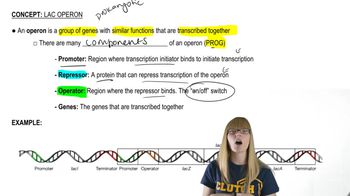
The lac repressor regulates gene expression by binding to the operator region of the lac operon, preventing transcription of downstream genes. This repression is lifted when an inducer molecule, like allolactose, binds the repressor, causing a conformational change and allowing gene expression.
Recommended video:
Guided course
04:27
Lac Operon Overview

Experimental Evidence for Repressor Activity

Genetic and biochemical experiments, such as mutations in the lacI gene leading to constitutive expression, demonstrate the repressor’s role. DNA-binding assays and operon activity measurements confirm that the lac repressor directly inhibits transcription by blocking RNA polymerase access.
Recommended video:
Guided course
02:33
Trp Repressor
Related Practice
Textbook Question

For the genotypes and conditions (lactose present or absent) shown in the following table, predict whether functional enzymes, nonfunctional enzymes, or no enzymes are made.

<IMAGE>

1032
views
Textbook Question

The locations of numerous lacI⁻ and lacIˢ mutations have been determined within the DNA sequence of the lacI gene. Among these, lacI⁻ mutations were found to occur in the 5′-upstream region of the gene, while lacIˢ mutations were found to occur farther downstream in the gene. Are the locations of the two types of mutations within the gene consistent with what is known about the function of the repressor that is the product of the lacI gene?

666
views
Textbook Question

Describe the experimental rationale that allowed the lac repressor to be isolated.

946
views
Textbook Question

Predict the effect on the inducibility of the lac operon of a mutation that disrupts the function of:

(a) The CRP gene, which encodes the CAP protein

(b) The CAP-binding site within the promoter.

951
views
Textbook Question

Erythritol, a natural sugar abundant in fruits and fermenting foods, is about 65 percent as sweet as table sugar and has about 95 percent fewer calories. It is 'tooth friendly' and generally devoid of negative side effects as a human consumable product. Pathogenic Brucella strains that catabolize erythritol contain four closely spaced genes, all involved in erythritol metabolism. One of the four genes (eryD) encodes a product that represses the expression of the other three genes. Erythritol catabolism is stimulated by erythritol. Present a simple regulatory model to account for the regulation of erythritol catabolism in Brucella. Does this system appear to be under inducible or repressible control?

554
views
Textbook Question

Describe the role of attenuation in the regulation of tryptophan biosynthesis.

892
views