Pearson+ LogoPearson+ Logo
Ch. 17 - Transcriptional Regulation in Eukaryotes
Klug - Concepts of Genetics  12th Edition
Klug12th EditionConcepts of Genetics ISBN: 9780135564776Not the one you use?Change textbook
Chapter 17, Problem 12

Enhancers can influence the transcription of genes far away on the same chromosome. How are the effects of enhancers restricted so that they do not exert inappropriate transcriptional activation of non-target genes?

Verified step by step guidance
1
Understand that enhancers are DNA sequences that can increase the transcription of specific target genes, even if they are located far away on the same chromosome.
Recognize that the specificity of enhancer action is controlled by the three-dimensional folding of chromatin, which brings enhancers into physical proximity with their target promoters through DNA looping.
Learn about insulator elements or boundary elements, which are DNA sequences that act as barriers to prevent enhancers from interacting with non-target genes by blocking the spread of activating signals.
Consider the role of architectural proteins, such as CTCF and cohesin, which help organize chromatin loops and define topologically associating domains (TADs) that restrict enhancer-promoter interactions within specific regions.
Summarize that the combination of chromatin structure, insulators, and architectural proteins ensures that enhancers activate only their intended target genes, preventing inappropriate transcriptional activation of neighboring genes.

Verified video answer for a similar problem:

This video solution was recommended by our tutors as helpful for the problem above.
Video duration:
1m
Was this helpful?

Key Concepts

Here are the essential concepts you must grasp in order to answer the question correctly.

Enhancer-Promoter Specificity

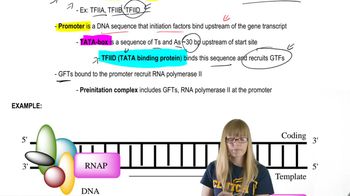
Enhancers regulate gene expression by interacting with specific promoters, often through DNA looping that brings them into close physical proximity. This specificity ensures that enhancers activate only their target genes despite being located far away on the chromosome.
Recommended video:
Guided course
09:16
Eukaryotic Transcription

Chromatin Architecture and Topologically Associating Domains (TADs)

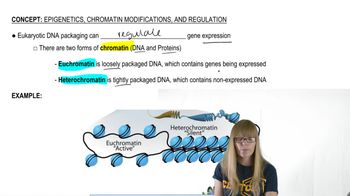
Chromosomes are organized into TADs, which are regions where DNA sequences interact more frequently with each other than with sequences outside the domain. TAD boundaries act as insulators, restricting enhancer activity to genes within the same domain and preventing inappropriate activation of neighboring genes.
Recommended video:

Insulator Elements and Boundary Proteins

Insulators are DNA elements bound by proteins like CTCF that block enhancer-promoter interactions across domains. These boundary elements create physical barriers that prevent enhancers from activating non-target genes, maintaining precise gene regulation.
Recommended video: