Pearson+ LogoPearson+ Logo
Ch. 17 - Transcriptional Regulation in Eukaryotes
Klug - Concepts of Genetics  12th Edition
Klug12th EditionConcepts of Genetics ISBN: 9780135564776Not the one you use?Change textbook
Chapter 17, Problem 14

Compare the control of gene regulation in eukaryotes and bacteria at the level of initiation of transcription. How do the regulatory mechanisms work? What are the similarities and differences in these two types of organisms in terms of the specific components of the regulatory mechanisms?

Verified step by step guidance
1
Understand that gene regulation at the level of transcription initiation involves controlling whether RNA polymerase can bind to the DNA and begin transcribing a gene. This process is critical for both bacteria and eukaryotes, but the mechanisms differ due to differences in cellular complexity.
In bacteria, transcription initiation is primarily regulated by the binding of RNA polymerase to the promoter region of the DNA. This process is influenced by sigma factors (which help RNA polymerase recognize specific promoters) and regulatory proteins such as repressors and activators. Repressors bind to operator sequences to block RNA polymerase, while activators enhance RNA polymerase binding.
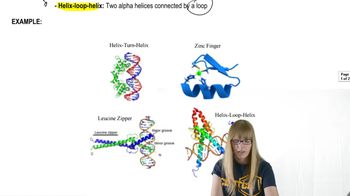
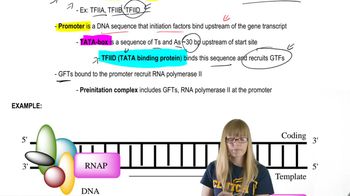
In eukaryotes, transcription initiation is more complex and involves multiple levels of regulation. RNA polymerase II requires general transcription factors (GTFs) to bind to the promoter. Additionally, regulatory elements such as enhancers and silencers, which are often located far from the promoter, interact with transcription factors and coactivators or corepressors to modulate transcription.
Compare the similarities: Both bacteria and eukaryotes use regulatory proteins to control transcription initiation. In both systems, DNA-binding proteins play a key role in recognizing specific sequences in the DNA to regulate RNA polymerase activity.
Compare the differences: Bacterial regulation is simpler and often involves operons (clusters of genes transcribed together), while eukaryotic regulation involves chromatin remodeling, a more complex promoter structure, and distal regulatory elements. Eukaryotes also rely on the modification of histones and the recruitment of mediator complexes to facilitate transcription initiation.

Verified video answer for a similar problem:

This video solution was recommended by our tutors as helpful for the problem above.
Video duration:
1m
Was this helpful?

Key Concepts

Here are the essential concepts you must grasp in order to answer the question correctly.

Gene Regulation

Gene regulation refers to the mechanisms that control the expression of genes, determining when and how much of a gene product is produced. In both eukaryotes and bacteria, regulation occurs primarily at the transcriptional level, influencing the initiation of RNA synthesis. Understanding these mechanisms is crucial for comparing how different organisms manage gene expression in response to environmental and developmental cues.
Recommended video:
Guided course
09:22
Review of Regulation

Transcription Initiation in Eukaryotes

In eukaryotes, transcription initiation involves a complex assembly of transcription factors, enhancers, and the RNA polymerase II enzyme at the promoter region of a gene. This process is highly regulated and often requires chromatin remodeling to make DNA accessible. Eukaryotic gene regulation is characterized by its complexity, involving multiple layers of control, including epigenetic modifications and RNA processing.
Recommended video:
Guided course
09:16
Eukaryotic Transcription

Transcription Initiation in Bacteria

In bacteria, transcription initiation is simpler and primarily involves the binding of RNA polymerase to a promoter region, often facilitated by sigma factors. Bacterial gene regulation typically relies on operons, where multiple genes are co-regulated, allowing for efficient response to environmental changes. This streamlined approach contrasts with the more intricate regulatory networks found in eukaryotes, highlighting fundamental differences in gene expression control.
Recommended video:
Guided course
09:16
Eukaryotic Transcription