Pearson+ LogoPearson+ Logo
Ch. 17 - Transcriptional Regulation in Eukaryotes
Klug - Concepts of Genetics  12th Edition
Klug12th EditionConcepts of Genetics ISBN: 9780135564776Not the one you use?Change textbook
Chapter 17, Problem 13

Describe the manner in which activators and repressors influence the rate of transcription initiation. How might chromatin structure be involved in such regulation?

Verified step by step guidance
1
Begin by defining activators and repressors as types of transcription factors that influence gene expression by binding to specific DNA sequences near the promoter region of a gene.
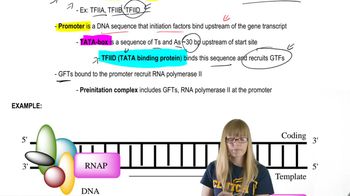
Explain that activators increase the rate of transcription initiation by facilitating the recruitment or stabilization of RNA polymerase and the general transcription machinery at the promoter, often by interacting with the mediator complex or other coactivators.
Describe that repressors decrease transcription initiation by blocking the binding of activators or RNA polymerase, recruiting corepressors, or modifying chromatin to a less accessible state, thereby preventing transcription machinery assembly.
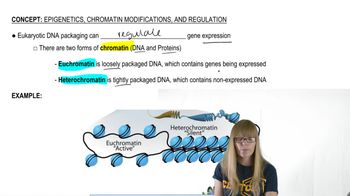
Introduce the concept of chromatin structure, emphasizing that DNA is wrapped around histone proteins forming nucleosomes, which can be tightly packed (heterochromatin) or loosely packed (euchromatin), affecting accessibility of DNA to transcription factors.
Explain how activators can promote chromatin remodeling to open chromatin structure (e.g., by recruiting histone acetyltransferases), making DNA more accessible, while repressors can recruit histone deacetylases or other chromatin-modifying enzymes to condense chromatin and reduce transcription.

Verified video answer for a similar problem:

This video solution was recommended by our tutors as helpful for the problem above.
Video duration:
1m
Was this helpful?

Key Concepts

Here are the essential concepts you must grasp in order to answer the question correctly.

Role of Activators and Repressors in Transcription

Activators are proteins that increase transcription by binding to specific DNA sequences and facilitating the recruitment of RNA polymerase and transcription machinery. Repressors, conversely, bind to DNA to block or hinder the assembly of these components, reducing transcription initiation. Their interaction with promoter or enhancer regions directly influences gene expression levels.
Recommended video:
Guided course
09:16
Eukaryotic Transcription

Transcription Initiation Mechanism

Transcription initiation involves the assembly of RNA polymerase and general transcription factors at the promoter region of a gene. This process is tightly regulated by various proteins, including activators and repressors, which modulate the accessibility and efficiency of the transcriptional machinery to start RNA synthesis.
Recommended video:
Guided course
09:16
Eukaryotic Transcription

Chromatin Structure and Gene Regulation

Chromatin structure affects gene expression by controlling DNA accessibility. Tightly packed chromatin (heterochromatin) restricts access to transcription factors, repressing transcription, while loosely packed chromatin (euchromatin) allows activators and RNA polymerase to bind DNA more easily. Modifications like histone acetylation can alter chromatin to regulate transcription.
Recommended video: