Pearson+ LogoPearson+ Logo
Ch. 18 - Post-transcriptional Regulation in Eukaryotes
Klug - Concepts of Genetics  12th Edition
Klug12th EditionConcepts of Genetics ISBN: 9780135564776Not the one you use?Change textbook
Chapter 18, Problem 9

AU-rich elements (AREs) are cis-elements in mRNAs that regulate stability and decay. How is it possible that a single mRNA sequence element can serve to stabilize an mRNA in some cases and lead to its decay in other scenarios?

Verified step by step guidance
1
Understand that AU-rich elements (AREs) are specific sequences found in the 3' untranslated region (3' UTR) of mRNAs that influence mRNA stability by interacting with various RNA-binding proteins.
Recognize that the effect of an ARE on mRNA stability depends on which proteins bind to it; some proteins promote mRNA decay, while others protect the mRNA from degradation.
Consider that the cellular context, such as the type of cell, developmental stage, or external signals, can influence which RNA-binding proteins are present and active, thereby altering the outcome of ARE binding.
Acknowledge that post-translational modifications of RNA-binding proteins or changes in their expression levels can switch the function of AREs from stabilizing to destabilizing the mRNA or vice versa.
Summarize that the dual role of AREs arises from their ability to serve as binding platforms for different regulatory proteins whose presence and activity vary depending on cellular conditions, leading to either mRNA stabilization or decay.

Verified video answer for a similar problem:

This video solution was recommended by our tutors as helpful for the problem above.
Video duration:
1m
Was this helpful?

Key Concepts

Here are the essential concepts you must grasp in order to answer the question correctly.

AU-rich Elements (AREs) in mRNA

AU-rich elements are specific sequences found in the 3' untranslated region of many mRNAs. They act as regulatory signals that influence mRNA stability by interacting with various RNA-binding proteins, thereby controlling the mRNA's lifespan and translation efficiency.
Recommended video:
Guided course
03:08
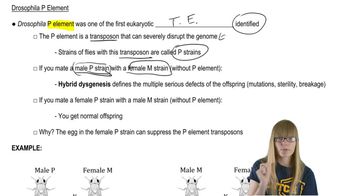
Drosophila P Element

RNA-binding Proteins and Their Dual Roles

Different RNA-binding proteins can recognize the same ARE sequence but have opposing effects. Some proteins promote mRNA decay by recruiting degradation machinery, while others stabilize the mRNA by protecting it from nucleases, allowing the same ARE to mediate different outcomes depending on the bound factors.
Recommended video:

Context-dependent Regulation of mRNA Stability

The effect of AREs on mRNA stability depends on cellular conditions, such as signaling pathways, cell type, or stress responses. These contexts influence which RNA-binding proteins are expressed or activated, thus determining whether the ARE leads to mRNA stabilization or decay.
Recommended video:
Guided course
09:22
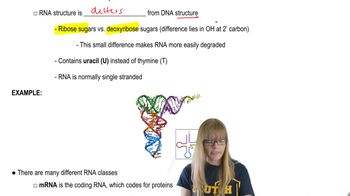
Review of Regulation