Pearson+ LogoPearson+ Logo
Ch. 19 - Epigenetics
Klug - Concepts of Genetics  12th Edition
Klug12th EditionConcepts of Genetics ISBN: 9780135564776Not the one you use?Change textbook
Chapter 19, Problem 7

Describe how reversible chemical changes to DNA and histones are linked to chromatin modification.

Verified step by step guidance
1
Begin by defining chromatin as the complex of DNA and proteins, mainly histones, that package DNA into a compact, organized structure within the nucleus.
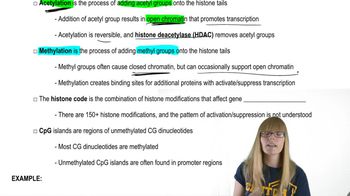
Explain that reversible chemical changes, also known as epigenetic modifications, occur on DNA (such as DNA methylation) and histone proteins (such as acetylation, methylation, phosphorylation).
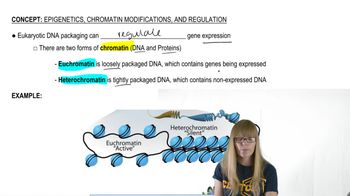
Describe how these chemical modifications alter the interaction between DNA and histones, affecting chromatin structure by either loosening (euchromatin) or tightening (heterochromatin) the DNA packaging.
Discuss that these changes are reversible because specific enzymes can add or remove these chemical groups, allowing dynamic regulation of gene accessibility and expression.
Conclude by linking these reversible modifications to chromatin remodeling, which controls gene expression by regulating how tightly DNA is wound around histones, thus influencing cellular function and identity.

Verified video answer for a similar problem:

This video solution was recommended by our tutors as helpful for the problem above.
Video duration:
1m
Was this helpful?

Key Concepts

Here are the essential concepts you must grasp in order to answer the question correctly.

Epigenetic Modifications

Epigenetic modifications refer to reversible chemical changes to DNA or histone proteins that affect gene expression without altering the DNA sequence. These changes include DNA methylation and histone modifications, which regulate chromatin structure and accessibility, influencing whether genes are active or silenced.
Recommended video:
Guided course
07:55
Histone Protein Modifications

Histone Modifications

Histone modifications involve the addition or removal of chemical groups such as acetyl, methyl, or phosphate groups to histone tails. These reversible changes alter chromatin compaction, either loosening it to promote gene expression or tightening it to repress transcription, thus playing a key role in chromatin remodeling.
Recommended video:
Guided course
07:55
Histone Protein Modifications

Chromatin Structure and Gene Regulation

Chromatin is the complex of DNA and histone proteins that packages genetic material in the nucleus. Its structure can be dynamically modified by chemical changes, which influence gene accessibility. Open chromatin (euchromatin) is associated with active transcription, while closed chromatin (heterochromatin) is linked to gene repression.
Recommended video: