Pearson+ LogoPearson+ Logo
Ch. 19 - Epigenetics
Klug - Concepts of Genetics  12th Edition
Klug12th EditionConcepts of Genetics ISBN: 9780135564776Not the one you use?Change textbook
Chapter 19, Problem 12

What is the histone code?

Verified step by step guidance
1
The histone code refers to the hypothesis that the transcription of genetic information encoded in DNA is, in part, regulated by chemical modifications to histone proteins, primarily on their N-terminal tails.
Histones are proteins that help package DNA into structural units called nucleosomes, which are the fundamental subunits of chromatin.
These modifications include methylation, acetylation, phosphorylation, ubiquitination, and sumoylation, among others, and they occur on specific amino acid residues of histone proteins.
Each type of modification can influence chromatin structure and function, thereby affecting gene expression by either promoting or repressing transcription.
The 'code' is thought to be a complex language of these modifications that can be read by other proteins to bring about changes in chromatin structure and gene activity.

Verified video answer for a similar problem:

This video solution was recommended by our tutors as helpful for the problem above.
Video duration:
1m
Was this helpful?

Key Concepts

Here are the essential concepts you must grasp in order to answer the question correctly.

Histones

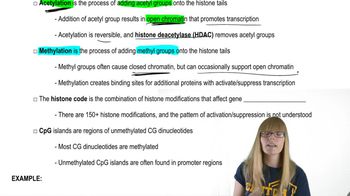
Histones are proteins that play a crucial role in the packaging of DNA into a compact, organized structure known as chromatin. They help regulate gene expression by controlling the accessibility of DNA to transcription machinery. Each histone protein can undergo various post-translational modifications, which influence chromatin structure and function.
Recommended video:
Guided course
07:55
Histone Protein Modifications

Post-Translational Modifications

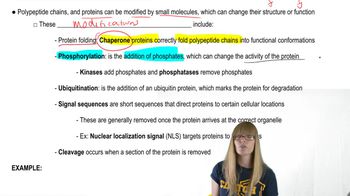
Post-translational modifications (PTMs) refer to the chemical modifications that occur on proteins after their synthesis. In the context of histones, these modifications include methylation, acetylation, phosphorylation, and ubiquitination. Each type of modification can alter the interaction between histones and DNA, thereby influencing gene expression and chromatin dynamics.
Recommended video:
Guided course
04:30
Post Translational Modifications

Gene Regulation

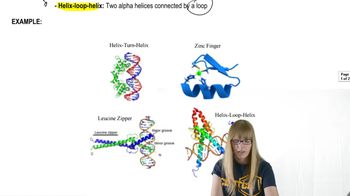
Gene regulation is the process by which cells control the expression of genes, determining when and how much of a gene product is made. The histone code contributes to gene regulation by providing a complex layer of information through the specific patterns of histone modifications. These patterns can signal whether a gene is active or silenced, thus playing a vital role in cellular function and differentiation.
Recommended video:
Guided course
09:22
Review of Regulation