Pearson+ LogoPearson+ Logo
Ch. 23 - Developmental Genetics
Klug - Concepts of Genetics  12th Edition
Klug12th EditionConcepts of Genetics ISBN: 9780135564776Not the one you use?Change textbook
Chapter 23, Problem 5

Distinguish between the syncytial blastoderm stage and the cellular blastoderm stage in Drosophila embryogenesis.

Verified step by step guidance
1
Understand that Drosophila embryogenesis begins with a single fertilized egg cell undergoing rapid nuclear divisions without cytokinesis, resulting in a syncytial blastoderm. This stage is characterized by multiple nuclei sharing a common cytoplasm.
Recognize that during the syncytial blastoderm stage, the nuclei migrate to the periphery of the embryo, forming a layer just beneath the plasma membrane. This arrangement is crucial for the subsequent cellularization process.
Learn that the transition to the cellular blastoderm stage involves the formation of individual cells around each nucleus. This process is called cellularization, where membranes grow inward to partition the cytoplasm and enclose each nucleus within its own cell.
Note that the cellular blastoderm stage marks the completion of cellularization, resulting in a single layer of cells surrounding the yolk. This stage is essential for the embryo to proceed to gastrulation and further development.
Compare the two stages: the syncytial blastoderm is a multinucleated structure without individual cells, while the cellular blastoderm consists of a monolayer of individual cells. This distinction highlights the importance of cellularization in establishing the basic body plan of the embryo.

Verified video answer for a similar problem:

This video solution was recommended by our tutors as helpful for the problem above.
Video duration:
2m
Was this helpful?

Key Concepts

Here are the essential concepts you must grasp in order to answer the question correctly.

Drosophila Embryogenesis

Drosophila embryogenesis refers to the developmental process of the fruit fly, which is a model organism in genetics. This process involves several stages, including the formation of the blastoderm, where the embryo undergoes rapid cell divisions and differentiation. Understanding the stages of embryogenesis is crucial for studying genetic regulation and developmental biology.
Recommended video:
Guided course
03:08
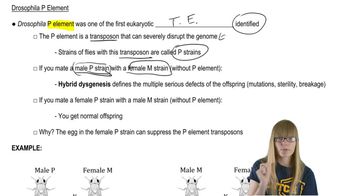
Drosophila P Element

Syncytial Blastoderm Stage

The syncytial blastoderm stage occurs early in Drosophila development, characterized by a single layer of nuclei within a common cytoplasm, resulting from rapid nuclear divisions without cell division. This stage allows for the rapid accumulation of gene products and is essential for establishing the body plan of the embryo. It is during this phase that maternal mRNAs and proteins are distributed to the nuclei.
Recommended video:
Guided course
03:46
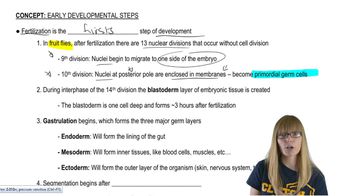
Drosophilia Development

Cellular Blastoderm Stage

The cellular blastoderm stage follows the syncytial blastoderm and is marked by the formation of individual cells as the cytoplasm divides around each nucleus. This transition is crucial for the establishment of cellular organization and the beginning of cell differentiation. At this stage, the embryo becomes more structured, allowing for the development of specific tissues and organs.
Recommended video:
Guided course
03:46
Drosophilia Development