Pearson+ LogoPearson+ Logo
Ch. 23 - Developmental Genetics
Klug - Concepts of Genetics  12th Edition
Klug12th EditionConcepts of Genetics ISBN: 9780135564776Not the one you use?Change textbook
Chapter 23, Problem 2

Write a short essay based on the concepts related to stages of development that outlines the role of differential transcription, gene control of cell fate, and the role of signaling systems in development.

Verified step by step guidance
1
Begin by explaining the concept of differential transcription. Describe how specific genes are turned on or off in different cells, leading to the production of distinct proteins that define cell identity and function. Highlight the importance of transcription factors and epigenetic modifications in regulating gene expression.
Discuss gene control of cell fate. Explain how certain genes act as 'master regulators' to determine the developmental pathway of a cell. Provide examples, such as the role of Hox genes in patterning body structures, and emphasize the importance of precise gene regulation in ensuring proper development.
Introduce the role of signaling systems in development. Explain how cells communicate with each other through signaling pathways, such as the Notch, Wnt, and Hedgehog pathways, to coordinate growth, differentiation, and spatial organization. Highlight the importance of signal transduction in responding to environmental cues and guiding developmental processes.
Connect the three concepts by describing how differential transcription, gene control of cell fate, and signaling systems work together to orchestrate development. For example, explain how signaling pathways can activate transcription factors that regulate gene expression, ultimately influencing cell fate decisions.
Conclude by emphasizing the significance of these mechanisms in development and their implications for understanding diseases caused by developmental errors, such as cancer or congenital disorders. Suggest how studying these processes can lead to advancements in regenerative medicine and genetic therapies.

Verified video answer for a similar problem:

This video solution was recommended by our tutors as helpful for the problem above.
Video duration:
3m
Was this helpful?

Key Concepts

Here are the essential concepts you must grasp in order to answer the question correctly.

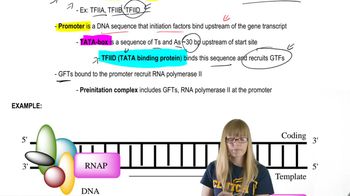
Differential Transcription

Differential transcription refers to the process by which specific genes are expressed at different levels in various cell types or developmental stages. This selective gene expression is crucial for cellular differentiation, allowing cells to acquire unique identities and functions. By regulating which genes are transcribed, cells can respond to internal and external signals, shaping their roles in the organism.
Recommended video:
Guided course
09:16
Eukaryotic Transcription

Gene Control of Cell Fate

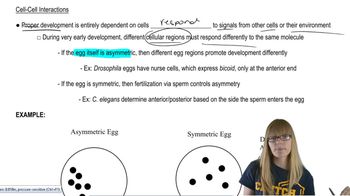
Gene control of cell fate involves the mechanisms by which specific genes determine the developmental pathways that cells will follow. This process is influenced by transcription factors and epigenetic modifications that activate or silence genes, guiding cells toward particular lineages. Understanding how gene control operates is essential for comprehending how multicellular organisms develop complex structures and functions.
Recommended video:
Guided course
03:52
Cell-cell interactions

Signaling Systems in Development

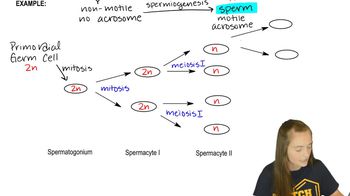
Signaling systems in development consist of various molecular pathways that facilitate communication between cells, influencing their growth, differentiation, and behavior. These systems often involve ligands, receptors, and downstream effectors that transmit signals, leading to coordinated responses during development. Proper functioning of these signaling pathways is vital for ensuring that cells develop correctly and form organized tissues and organs.
Recommended video:
Guided course
21:21
Gamete Development
Related Practice
Textbook Question

In the discussion, we have focused on large-scale as well as the inter- and intracellular events that take place during embryogenesis and the formation of adult structures. In particular, we discussed how the adult body plan is laid down by a cascade of gene expression, and the role of cell–cell communication in development. Based on your knowledge of these topics, answer several fundamental questions:

How did we discover that selector genes specify which adult structures will be formed by body segments?

370
views
Textbook Question

In the discussion, we have focused on large-scale as well as the inter- and intracellular events that take place during embryogenesis and the formation of adult structures. In particular, we discussed how the adult body plan is laid down by a cascade of gene expression, and the role of cell–cell communication in development. Based on your knowledge of these topics, answer several fundamental questions:

How did we learn about the levels of gene regulation involved in vulval development in C. elegans?

434
views
Textbook Question

In the discussion, we have focused on large-scale as well as the inter- and intracellular events that take place during embryogenesis and the formation of adult structures. In particular, we discussed how the adult body plan is laid down by a cascade of gene expression, and the role of cell–cell communication in development. Based on your knowledge of these topics, answer several fundamental questions:

How do we know that eye formation in all animals is controlled by a binary switch gene?

405
views
Textbook Question

Carefully distinguish between the terms differentiation and determination. Which phenomenon occurs initially during development?

523
views
Textbook Question

Nuclei from almost any source may be injected into Xenopus oocytes. Studies have shown that these nuclei remain active in transcription and translation. How can such an experimental system be useful in developmental genetic studies?

400
views
Textbook Question

Distinguish between the syncytial blastoderm stage and the cellular blastoderm stage in Drosophila embryogenesis.

681
views