Ch. 5 - Chromosome Mapping in Eukaryotes
Klug - Concepts of Genetics  12th Edition
Klug12th EditionConcepts of Genetics ISBN: 9780135564776Not the one you use?Change textbook
Chapter 5, Problem 20

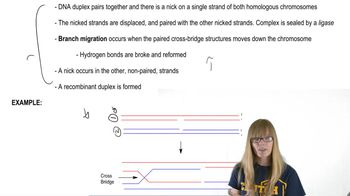
Are mitotic recombinations and sister chromatid exchanges effective in producing genetic variability in an individual? in the offspring of individuals?

Verified step by step guidance
1
Understand the definitions: Mitotic recombination is the exchange of genetic material between homologous chromosomes during mitosis, while sister chromatid exchange (SCE) is the exchange of DNA between sister chromatids during mitosis.
Consider the genetic consequences within an individual: Since mitotic recombination and SCE occur in somatic cells, they can create genetic variability among the cells of that individual, potentially leading to mosaicism or somatic mutations.
Analyze the impact on offspring: Because mitotic recombination and SCE happen in somatic cells and not in germ cells (sperm or egg), these events generally do not affect the genetic makeup of the offspring.
Contrast with meiotic recombination: Genetic variability in offspring primarily arises from meiotic recombination during gamete formation, which reshuffles alleles between homologous chromosomes in germ cells.
Summarize the effectiveness: Mitotic recombination and SCE contribute to genetic variability within an individual’s somatic cells but are not effective mechanisms for producing genetic variability in the offspring.

Verified video answer for a similar problem:

This video solution was recommended by our tutors as helpful for the problem above.
Video duration:
3m
Was this helpful?

Key Concepts

Here are the essential concepts you must grasp in order to answer the question correctly.

Mitotic Recombination

Mitotic recombination is a process during mitosis where homologous chromosomes exchange genetic material, leading to genetic changes in somatic cells. It can create genetic mosaicism within an individual but does not affect germ cells, so it generally does not contribute to genetic variability in offspring.
Recommended video:
Guided course
03:51
Recombination after Single Strand Breaks

Sister Chromatid Exchange (SCE)

Sister chromatid exchange involves the reciprocal exchange of DNA between sister chromatids during mitosis. Since sister chromatids are identical copies, SCE does not usually result in new genetic variation within the individual or offspring, but it can indicate DNA repair or genomic instability.
Recommended video:

Genetic Variability and Inheritance

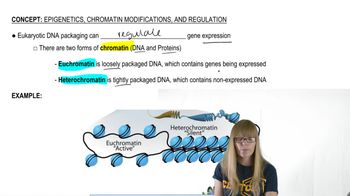
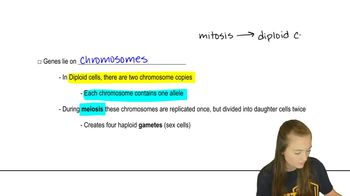
Genetic variability in offspring arises mainly from meiotic recombination and independent assortment during gamete formation. Changes occurring in somatic cells, like mitotic recombination or SCE, typically do not affect the germline and thus are not passed to offspring, limiting their role in inherited genetic diversity.
Recommended video:
Guided course
27:36
Diploid Genetics
Related Practice
Textbook Question

Drosophila females homozygous for the third chromosomal genes pink and ebony (the same genes from Problem 16) were crossed with males homozygous for the second chromosomal gene dumpy. Because these genes are recessive, all offspring were wild type (normal). F1 females were testcrossed to triply recessive males. If we assume that the two linked genes, pink and ebony, are 20 mu apart, predict the results of this cross. If the reciprocal cross were made (F1 males—where no crossing over occurs—with triply recessive females), how would the results vary, if at all?

768
views
Textbook Question

In Drosophila, two mutations, Stubble (Sb) and curled (cu), are linked on chromosome III. Stubble is a dominant gene that is lethal in a homozygous state, and curled is a recessive gene. If a female of the genotype

is to be mated to detect recombinants among her offspring, what male genotype would you choose as a mate?

1294
views
Textbook Question

If the cross described in Problem 18 were made, and if Sb and cu are 8.2 map units apart on chromosome III, and if 1000 offspring were recovered, what would be the outcome of the cross, assuming that equal numbers of males and females were observed?

540
views
Textbook Question

What possible conclusions can be drawn from the observations that in male Drosophila, no crossing over occurs, and that during meiosis, synaptonemal complexes are not seen in males but are observed in females where crossing over occurs?

500
views
Textbook Question

An organism of the genotype AaBbCc was testcrossed to a triply recessive organism (aabbcc). The genotypes of the progeny are presented in the following table.

If these three genes were all assorting independently, how many genotypic and phenotypic classes would result in the offspring, and in what proportion, assuming simple dominance and recessiveness in each gene pair?

930
views
Textbook Question

An organism of the genotype AaBbCc was testcrossed to a triply recessive organism (aabbcc). The genotypes of the progeny are presented in the following table.

Answer part (a) again, assuming the three genes are so tightly linked on a single chromosome that no crossover gametes were recovered in the sample of offspring.

1296
views