Pearson+ LogoPearson+ Logo
Ch. 6 - Genetic Analysis and Mapping in Bacteria and Bacteriophages
Klug - Concepts of Genetics  12th Edition
Klug12th EditionConcepts of Genetics ISBN: 9780135564776Not the one you use?Change textbook
Chapter 6, Problem 1e

In this chapter, we have focused on genetic systems present in bacteria and on the viruses that use bacteria as hosts (bacteriophages). In particular, we discussed mechanisms by which bacteria and their phages undergo genetic recombination, which allows geneticists to map bacterial and bacteriophage chromosomes. In the process, we found many opportunities to consider how this information was acquired. From the explanations given in the chapter, what answers would you propose to the following questions? How do we know that intergenic exchange occurs in bacteriophages?

Verified step by step guidance
1
Understand the concept of intergenic exchange: Intergenic exchange refers to the recombination of genetic material between different genes. In bacteriophages, this process can be studied by analyzing the genetic outcomes of co-infection experiments involving two or more phages with distinct genetic markers.
Review the experimental setup: Scientists often use bacteriophages with known genetic markers (e.g., mutations in specific genes) to infect a bacterial host. By analyzing the progeny phages, they can determine whether recombination has occurred between the genetic markers.
Analyze the evidence of recombination: If intergenic exchange occurs, the progeny phages will exhibit new combinations of genetic markers that were not present in the parental phages. For example, if two parental phages have markers A and B on one phage and a and b on the other, recombination can produce progeny with combinations such as A-b or a-B.
Use statistical analysis to confirm recombination: The frequency of recombinant progeny can be compared to the expected outcomes if no recombination occurred. A higher-than-expected frequency of recombinant types provides strong evidence for intergenic exchange.
Consider the role of mapping: By analyzing the frequency of recombination between different genetic markers, geneticists can construct a genetic map of the bacteriophage genome. This map provides further evidence of intergenic exchange and helps to determine the relative positions of genes on the chromosome.

Verified video answer for a similar problem:

This video solution was recommended by our tutors as helpful for the problem above.
Video duration:
1m
Was this helpful?

Key Concepts

Here are the essential concepts you must grasp in order to answer the question correctly.

Intergenic Exchange

Intergenic exchange refers to the process by which genetic material is exchanged between different genes, often through mechanisms like recombination. In bacteriophages, this can occur when two different phages infect the same bacterial cell, leading to the mixing of their genetic material. This exchange can result in new phage variants with different traits, which is crucial for understanding phage evolution and adaptability.
Recommended video:
Guided course
04:06
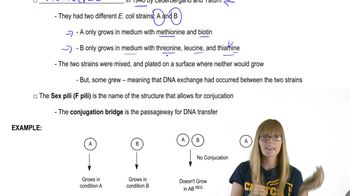
Conjugation Overview

Genetic Recombination

Genetic recombination is a fundamental biological process where genetic material is rearranged to produce new combinations of alleles. In the context of bacteriophages, recombination can occur during the lytic cycle when phages replicate within a host. This process is essential for mapping bacterial and phage chromosomes, as it provides insights into gene location and function through the analysis of recombinant phage genomes.
Recommended video:
Guided course
03:37
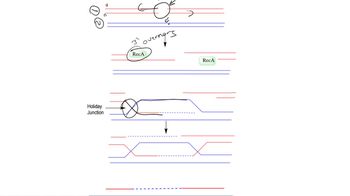
Recombination after Double Strand Breaks

Bacteriophage Genetics

Bacteriophage genetics involves the study of the genetic makeup and behavior of bacteriophages, which are viruses that infect bacteria. Understanding the genetic systems of bacteriophages is vital for exploring their life cycles, interactions with bacterial hosts, and mechanisms of genetic exchange. This knowledge helps researchers utilize phages in biotechnology and medicine, particularly in phage therapy to combat antibiotic-resistant bacteria.
Recommended video:
Guided course
06:04
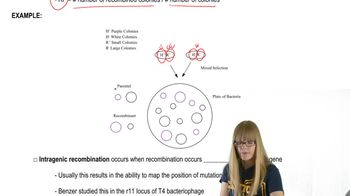
Mapping Bacteriophages