Pearson+ LogoPearson+ Logo
Ch. 6 - Genetic Analysis and Mapping in Bacteria and Bacteriophages
Klug - Concepts of Genetics  12th Edition
Klug12th EditionConcepts of Genetics ISBN: 9780135564776Not the one you use?Change textbook
Chapter 6, Problem 1d

How do we know that bacteriophages recombine genetic material through transduction and that cell-to-cell contact is not essential for transduction to occur?

Verified step by step guidance
1
Understand the concept of transduction: Transduction is a process in which bacteriophages (viruses that infect bacteria) transfer genetic material from one bacterial cell to another. This process does not require direct cell-to-cell contact, unlike conjugation, which involves physical contact between bacterial cells.
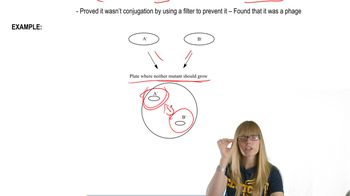
Review experimental evidence for transduction: Scientists demonstrated transduction by using a U-tube experiment with a filter that prevents direct contact between bacterial cells. In this setup, bacteriophages could pass through the filter, but bacterial cells could not. Genetic recombination was observed, indicating that the transfer of genetic material occurred via the bacteriophages and not through direct contact.
Analyze the role of bacteriophages in genetic recombination: During the lytic or lysogenic cycle, bacteriophages can accidentally package fragments of the host bacterial DNA into their capsids. When these phages infect another bacterial cell, they introduce the DNA from the previous host, leading to genetic recombination in the recipient cell.
Differentiate between generalized and specialized transduction: Generalized transduction occurs when random fragments of bacterial DNA are packaged into a phage during the lytic cycle, while specialized transduction involves the transfer of specific bacterial genes near the prophage insertion site during the lysogenic cycle. Both processes demonstrate that bacteriophages can mediate genetic recombination without requiring cell-to-cell contact.
Conclude based on the evidence: The U-tube experiment and the mechanisms of generalized and specialized transduction provide strong evidence that bacteriophages facilitate genetic recombination through transduction and that this process does not depend on direct cell-to-cell contact.

Verified video answer for a similar problem:

This video solution was recommended by our tutors as helpful for the problem above.
Video duration:
47s
Was this helpful?

Key Concepts

Here are the essential concepts you must grasp in order to answer the question correctly.

Transduction

Transduction is a process of genetic recombination in which bacteriophages transfer genetic material from one bacterium to another. This occurs when a phage infects a bacterial cell, incorporates a fragment of the host's DNA, and then transfers this DNA to a new bacterial host during subsequent infections. This mechanism demonstrates that genetic material can be exchanged without direct cell-to-cell contact, distinguishing it from other forms of genetic exchange like conjugation.
Recommended video:

Bacteriophages

Bacteriophages, or phages, are viruses that specifically infect bacteria. They play a crucial role in the genetic exchange among bacterial populations by facilitating transduction. Understanding the life cycle of bacteriophages, including their ability to integrate bacterial DNA into their own genome, is essential for comprehending how they contribute to genetic recombination and diversity in bacterial species.
Recommended video:
Guided course
06:04
Mapping Bacteriophages

Genetic Recombination

Genetic recombination refers to the process by which genetic material is rearranged or exchanged between organisms, leading to new genetic combinations. In bacteria, this can occur through transformation, conjugation, and transduction. The study of genetic recombination is vital for mapping bacterial and phage chromosomes, as it provides insights into genetic diversity, evolution, and the mechanisms underlying bacterial adaptation.
Recommended video:
Guided course
03:37
Recombination after Double Strand Breaks
Related Practice
Textbook Question

How do we know that genes exist in bacteria and bacteriophages?

357
views
Textbook Question

How do we know that bacteria undergo genetic recombination, allowing the transfer of genes from one organism to another?

405
views
Textbook Question

How do we know whether or not genetic recombination between bacteria involves cell-to-cell contact?

485
views
Textbook Question

In this chapter, we have focused on genetic systems present in bacteria and on the viruses that use bacteria as hosts (bacteriophages). In particular, we discussed mechanisms by which bacteria and their phages undergo genetic recombination, which allows geneticists to map bacterial and bacteriophage chromosomes. In the process, we found many opportunities to consider how this information was acquired. From the explanations given in the chapter, what answers would you propose to the following questions? How do we know that intergenic exchange occurs in bacteriophages?

471
views
Textbook Question

In this chapter, we have focused on genetic systems present in bacteria and on the viruses that use bacteria as hosts (bacteriophages). In particular, we discussed mechanisms by which bacteria and their phages undergo genetic recombination, which allows geneticists to map bacterial and bacteriophage chromosomes. In the process, we found many opportunities to consider how this information was acquired. From the explanations given in the chapter, what answers would you propose to the following questions? How do we know that in bacteriophage T4 the rII locus is subdivided into two regions, or cistrons?

428
views
Textbook Question

Write a short summary that contrasts how recombination occurs in bacteria and bacteriophages.

695
views