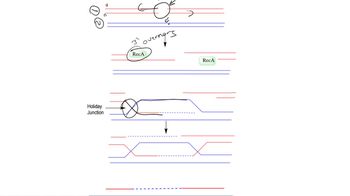
How do we know whether or not genetic recombination between bacteria involves cell-to-cell contact?

Klug 12th Edition
Ch. 6 - Genetic Analysis and Mapping in Bacteria and Bacteriophages
Problem 1fIn this chapter, we have focused on genetic systems present in bacteria and on the viruses that use bacteria as hosts (bacteriophages). In particular, we discussed mechanisms by which bacteria and their phages undergo genetic recombination, which allows geneticists to map bacterial and bacteriophage chromosomes. In the process, we found many opportunities to consider how this information was acquired. From the explanations given in the chapter, what answers would you propose to the following questions? How do we know that in bacteriophage T4 the rII locus is subdivided into two regions, or cistrons?
Verified step by step guidance
Verified video answer for a similar problem:
Key Concepts
Cistrons
Genetic Recombination
Mapping Genetic Loci
How do we know that bacteriophages recombine genetic material through transduction and that cell-to-cell contact is not essential for transduction to occur?
In this chapter, we have focused on genetic systems present in bacteria and on the viruses that use bacteria as hosts (bacteriophages). In particular, we discussed mechanisms by which bacteria and their phages undergo genetic recombination, which allows geneticists to map bacterial and bacteriophage chromosomes. In the process, we found many opportunities to consider how this information was acquired. From the explanations given in the chapter, what answers would you propose to the following questions? How do we know that intergenic exchange occurs in bacteriophages?
Write a short summary that contrasts how recombination occurs in bacteria and bacteriophages.
With respect to F⁺ and F⁻ bacterial matings, answer the following questions: How was it established that physical contact between cells was necessary?
With respect to F⁺ and F⁻ bacterial matings, answer the following questions: How was it established that chromosome transfer was unidirectional?