Pearson+ LogoPearson+ Logo
Ch. 7 - Sex Determination and Sex Chromosomes
Klug - Concepts of Genetics  12th Edition
Klug12th EditionConcepts of Genetics ISBN: 9780135564776Not the one you use?Change textbook
Chapter 7, Problem 10a

An insect species is discovered in which the heterogametic sex is unknown. An X-linked recessive mutation for reduced wing (rw) is discovered. Contrast the F1 and F2 generations from a cross between a female with reduced wings and a male with normal-sized wings when the female is the heterogametic sex.

Verified step by step guidance
1
Step 1: Identify the sex determination system and the genotypes of the parents. Since the female is heterogametic, the sex chromosomes are likely ZW for females and ZZ for males (opposite to the XY system). The mutation is X-linked recessive, but here it corresponds to the Z chromosome, so the allele for reduced wings (rw) is on the Z chromosome.
Step 2: Assign genotypes to the parents. The female with reduced wings is heterogametic (ZW), so she must carry the rw allele on her Z chromosome (Z^rw W). The male with normal wings is homogametic (ZZ) and must have normal alleles (Z^+ Z^+).
Step 3: Determine the possible gametes from each parent. The female can produce gametes Z^rw and W, while the male produces gametes Z^+ only (since both chromosomes are Z^+).
Step 4: Predict the F1 offspring genotypes by combining the gametes. The F1 males will be Z^+ W (normal wings), and the F1 females will be Z^rw Z^+ (carriers or affected depending on dominance).
Step 5: For the F2 generation, cross F1 individuals considering their genotypes and sex chromosomes. Analyze the expected phenotypic ratios by tracking the inheritance of the rw allele on the Z chromosome, remembering that females are ZW and males are ZZ.

Verified video answer for a similar problem:

This video solution was recommended by our tutors as helpful for the problem above.
Video duration:
4m
Was this helpful?

Key Concepts

Here are the essential concepts you must grasp in order to answer the question correctly.

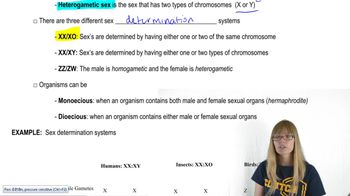
Heterogametic and Homogametic Sex Determination

Heterogametic sex produces two different types of sex chromosomes (e.g., XY in males), while homogametic sex produces identical sex chromosomes (e.g., XX in females). Identifying which sex is heterogametic is crucial for predicting inheritance patterns of sex-linked traits, as it affects how alleles on sex chromosomes are transmitted.
Recommended video:
Guided course
04:24
Sex Determination

X-linked Recessive Inheritance

X-linked recessive traits are caused by mutations on the X chromosome and typically manifest in the heterogametic sex if they carry the mutant allele, since they have only one X chromosome. In homogametic individuals, two copies of the recessive allele are needed for expression. This pattern influences phenotypic ratios in offspring.
Recommended video:
Guided course
09:30
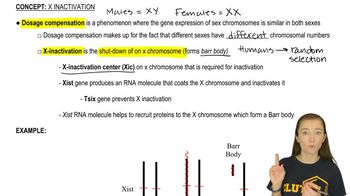
X-Inactivation

Genetic Crosses and Generational Analysis (F1 and F2)

F1 generation results from the initial parental cross, while F2 is produced by interbreeding F1 individuals. Analyzing phenotypes and genotypes across these generations helps reveal inheritance patterns, especially when sex linkage and heterogamety are involved, allowing prediction of offspring ratios under different genetic assumptions.
Recommended video:
Guided course
02:48
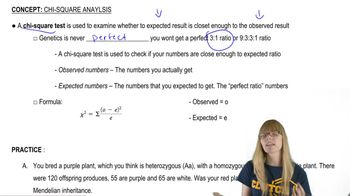
Chi Square Analysis