Pearson+ LogoPearson+ Logo
Ch. 9 - Extranuclear Inheritance
Klug - Concepts of Genetics  12th Edition
Klug12th EditionConcepts of Genetics ISBN: 9780135564776Not the one you use?Change textbook
Chapter 9, Problem 8

In a cross of Lymnaea, the snail contributing the eggs was dextral but of unknown genotype. Both the genotype and the phenotype of the other snail are unknown. All F₁ offspring exhibited dextral coiling. Ten of the F₁ snails were allowed to undergo self-fertilization. One-half produced only dextrally coiled offspring, whereas the other half produced only sinistrally coiled offspring. What were the genotypes of the original parents?

Verified step by step guidance
1
Understand the inheritance pattern: In Lymnaea snails, coiling direction is determined by maternal effect genes. The phenotype of the offspring is influenced by the genotype of the mother, not the offspring's own genotype.
Analyze the F₁ generation: All F₁ offspring exhibited dextral coiling. This indicates that the maternal genotype of the dextral snail contributing the eggs must have been dominant for dextral coiling (D). The genotype of the other parent is unknown at this stage.
Examine the self-fertilization results: Half of the F₁ snails produced only dextral offspring, while the other half produced only sinistral offspring. This suggests that the F₁ snails were heterozygous (Dd) and homozygous recessive (dd), respectively.
Determine the parental genotypes: For the F₁ generation to include both heterozygous (Dd) and homozygous recessive (dd) individuals, the original parents must have been a homozygous dominant dextral snail (DD) and a homozygous recessive sinistral snail (dd).
Summarize the findings: The original parents were DD (dextral snail contributing eggs) and dd (sinistral snail contributing sperm). The maternal effect ensured that all F₁ offspring exhibited dextral coiling, regardless of their genotype.

Verified video answer for a similar problem:

This video solution was recommended by our tutors as helpful for the problem above.
Video duration:
3m
Was this helpful?

Key Concepts

Here are the essential concepts you must grasp in order to answer the question correctly.

Genotype and Phenotype

Genotype refers to the genetic makeup of an organism, specifically the alleles it possesses for a particular trait. Phenotype, on the other hand, is the observable expression of that genotype, influenced by both genetic and environmental factors. In this question, understanding the relationship between the genotypes of the snails and their dextral or sinistral coiling is crucial for deducing the parental genotypes.
Recommended video:
Guided course
07:52
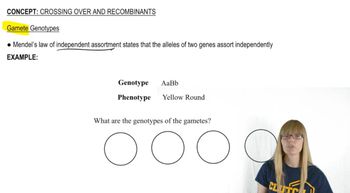
Gamete Genotypes

Mendelian Inheritance

Mendelian inheritance describes the patterns of inheritance for traits controlled by single genes, as established by Gregor Mendel. Key principles include the segregation of alleles during gamete formation and the independent assortment of different traits. The F₁ generation's phenotypes and the subsequent self-fertilization results provide insights into the inheritance patterns at play in the Lymnaea snails.
Recommended video:
Guided course
05:13
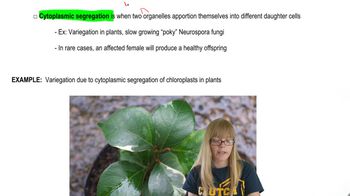
Organelle Inheritance

Coiling Direction in Snails

In Lymnaea snails, coiling direction (dextral or sinistral) is a trait influenced by genetic factors, often determined by a single gene with two alleles. The dextral phenotype is typically dominant over the sinistral phenotype. The observation that some F₁ offspring produced only dextrally coiled snails while others produced only sinistrally coiled snails suggests a specific genetic configuration in the parental generation that can be analyzed to determine their genotypes.
Recommended video:
Guided course
03:38
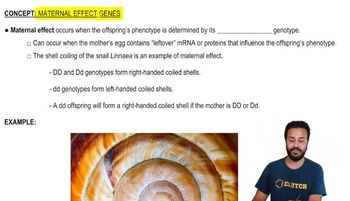
Maternal Effect
Related Practice
Textbook Question

A plant may have green, white, or green-and-white (variegated) leaves on its branches, owing to a mutation in the chloroplast that prevents color from developing. Predict the results of the following crosses:


  Ovule Source        Pollen Source

(a) Green branch    x  White branch

(b) White branch     x  Green branch

(c) Variegated branch x  Green branch

(d) Green branch    x  Variegated branch

601
views
Textbook Question

In diploid yeast strains, sporulation and subsequent meiosis can produce haploid ascospores, which may fuse to reestablish diploid cells. When ascospores from a segregational petite strain fuse with those of a normal wild-type strain, the diploid zygotes are all normal. Following meiosis, ascospores are petite and normal. Is the segregational petite phenotype inherited as a dominant or a recessive trait?

422
views
Textbook Question

Predict the results of a cross between ascospores from a segregational petite strain and a neutral petite strain. Indicate the phenotype of the zygote and the ascospores it may subsequently produce.

459
views
Textbook Question

In Drosophila subobscura, the presence of a recessive gene called grandchildless (gs) causes the offspring of homozygous females, but not those of homozygous males, to be sterile. Can you offer an explanation as to why females and not males are affected by the mutant gene?

450
views
Textbook Question

A male mouse from a true-breeding strain of hyperactive animals is crossed with a female mouse from a true-breeding strain of lethargic animals. (These are both hypothetical strains.) All the progeny are lethargic. In the F₂ generation, all offspring are lethargic. What is the best genetic explanation for these observations? Propose a cross to test your explanation.

460
views
Textbook Question

Consider the case where a mutation occurs that disrupts translation in a single human mitochondrion found in the oocyte participating in fertilization. What is the likely impact of this mutation on the offspring arising from this oocyte?

476
views