Ch. 9 - Extranuclear Inheritance
Klug - Concepts of Genetics  12th Edition
Klug12th EditionConcepts of Genetics ISBN: 9780135564776Not the one you use?Change textbook
Chapter 9, Problem 12

What is the endosymbiotic theory, and why is this theory relevant to the study of extranuclear DNA in eukaryotic organelles?

Verified step by step guidance
1
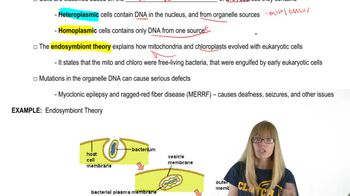
The endosymbiotic theory proposes that certain organelles in eukaryotic cells, such as mitochondria and chloroplasts, originated from free-living prokaryotic cells that were engulfed by an ancestral eukaryotic cell. Over time, these prokaryotes formed a symbiotic relationship with the host cell.
Explain that mitochondria and chloroplasts have their own DNA, which is distinct from the nuclear DNA of the eukaryotic cell. This DNA is circular, similar to the DNA found in prokaryotes, supporting the idea that these organelles were once independent prokaryotic organisms.
Discuss how the study of extranuclear DNA (DNA outside the nucleus) in mitochondria and chloroplasts provides evidence for the endosymbiotic theory. For example, the genetic sequences of mitochondrial and chloroplast DNA are more similar to bacterial DNA than to eukaryotic nuclear DNA.
Highlight the relevance of this theory to genetics by explaining that extranuclear DNA is inherited differently from nuclear DNA. For instance, mitochondrial DNA is typically inherited maternally in most organisms, which has implications for studying inheritance patterns and evolutionary relationships.
Conclude by emphasizing that the endosymbiotic theory helps us understand the origin of eukaryotic cells and the role of extranuclear DNA in cellular function, evolution, and inheritance.

Verified video answer for a similar problem:

This video solution was recommended by our tutors as helpful for the problem above.
Video duration:
1m
Was this helpful?

Key Concepts

Here are the essential concepts you must grasp in order to answer the question correctly.

Endosymbiotic Theory

The endosymbiotic theory posits that certain organelles, specifically mitochondria and chloroplasts, originated from free-living prokaryotic organisms that were engulfed by ancestral eukaryotic cells. This theory explains how these organelles have their own DNA, which is distinct from the nuclear DNA of the host cell, supporting the idea of a symbiotic relationship that evolved over time.
Recommended video:
Guided course
04:11
Organelle DNA Characteristics

Extranuclear DNA

Extranuclear DNA refers to genetic material located outside the nucleus, primarily found in mitochondria and chloroplasts. This DNA is circular and resembles bacterial DNA, which provides evidence for the endosymbiotic theory, as it suggests these organelles were once independent prokaryotes. Understanding extranuclear DNA is crucial for studying organelle function and inheritance patterns.
Recommended video:
Guided course
01:45
DNA Proofreading

Eukaryotic Organelles

Eukaryotic organelles are specialized structures within eukaryotic cells that perform distinct functions, such as energy production, photosynthesis, and protein synthesis. Mitochondria and chloroplasts are key organelles that contain their own DNA, which is significant for understanding cellular processes and the evolutionary history of eukaryotic cells, as they are believed to have originated from endosymbiotic events.
Recommended video:
Guided course
04:11
Organelle DNA Characteristics
Related Practice
Textbook Question

In Drosophila subobscura, the presence of a recessive gene called grandchildless (gs) causes the offspring of homozygous females, but not those of homozygous males, to be sterile. Can you offer an explanation as to why females and not males are affected by the mutant gene?

438
views
Textbook Question

A male mouse from a true-breeding strain of hyperactive animals is crossed with a female mouse from a true-breeding strain of lethargic animals. (These are both hypothetical strains.) All the progeny are lethargic. In the F₂ generation, all offspring are lethargic. What is the best genetic explanation for these observations? Propose a cross to test your explanation.

443
views
Textbook Question

Consider the case where a mutation occurs that disrupts translation in a single human mitochondrion found in the oocyte participating in fertilization. What is the likely impact of this mutation on the offspring arising from this oocyte?

467
views
Textbook Question

Earlier, we described CC, the cat created by nuclear transfer cloning, whereby a diploid nucleus from one cell is injected into an enucleated egg cell to create an embryo. Cattle, sheep, rats, dogs, and several other species have been cloned using nuclei from somatic cells. Embryos and adults produced by this approach often show a number of different mitochondrial defects. Explain possible reasons for the prevalence of mitochondrial defects in embryos created by nuclear transfer cloning.

448
views
Textbook Question

Mitochondrial replacement therapy (MRT) offers a potential solution for women with mtDNA-based diseases to have healthy children. Based on what you know about the importance of nuclear gene products to mitochondrial functions, will MRT ensure that children will not inherit or develop a mtDNA-based diseases?

519
views
Textbook Question

The specification of the anterior–posterior axis in Drosophila embryos is initially controlled by various gene products that are synthesized and stored in the mature egg following oogenesis. Mutations in these genes result in abnormalities of the axis during embryogenesis. These mutations illustrate maternal effect. How do such mutations vary from those produced by organelle heredity? Devise a set of parallel crosses and expected outcomes involving mutant genes that contrast maternal effect and organelle heredity.

806
views