Pearson+ LogoPearson+ Logo
Ch.14 Carboxylic Acids, Esters, Amines, and Amides
Timberlake - Chemistry: An Introduction to General, Organic, and Biological Chemistry 13th Edition
Timberlake13th EditionChemistry: An Introduction to General, Organic, and Biological ChemistryISBN: 9780134421353Not the one you use?Change textbook
Chapter 14, Problem 35b

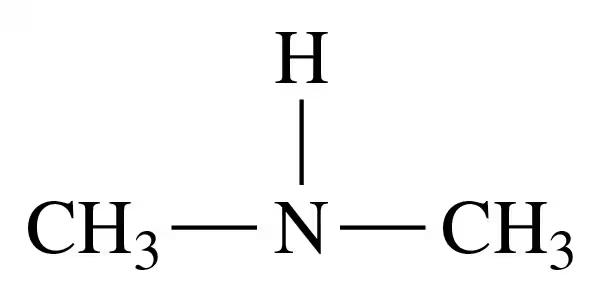
Indicate if each of the following is soluble in water. Explain.
b. Structural formula of dimethylamine, showing nitrogen bonded to two methyl groups and one hydrogen atom.

Verified step by step guidance
1
Identify the compound in the image provided. If the image is not visible, the compound's name or formula should be clarified to proceed with the analysis.
Determine the type of compound (ionic or covalent). Ionic compounds are generally composed of a metal and a nonmetal, while covalent compounds are composed of nonmetals.
Apply solubility rules for ionic compounds. For example, compounds containing alkali metal cations (e.g., Na⁺, K⁺) or ammonium (NH₄⁺), as well as nitrates (NO₃⁻) and acetates (CH₃COO⁻), are typically soluble in water.
For covalent compounds, consider their polarity. Polar covalent compounds (e.g., those with O-H or N-H bonds) are more likely to dissolve in water due to hydrogen bonding, while nonpolar covalent compounds are generally insoluble.
Explain the reasoning based on the compound's structure and the solubility rules or polarity considerations. Conclude whether the compound is soluble or insoluble in water.

Verified video answer for a similar problem:

This video solution was recommended by our tutors as helpful for the problem above.
Video duration:
2m
Was this helpful?

Key Concepts

Here are the essential concepts you must grasp in order to answer the question correctly.

Solubility

Solubility refers to the ability of a substance to dissolve in a solvent, typically water. It is influenced by factors such as temperature, pressure, and the nature of the solute and solvent. Polar substances tend to dissolve well in polar solvents like water, while nonpolar substances do not. Understanding solubility is crucial for predicting how substances interact in aqueous solutions.
Recommended video:
Guided course
00:28
Solubility Rules

Polarity

Polarity is a property of molecules that describes the distribution of electrical charge. Molecules with a significant difference in electronegativity between atoms exhibit polar characteristics, leading to partial positive and negative charges. Water is a polar molecule, which allows it to effectively dissolve other polar substances, while nonpolar molecules, such as oils, do not interact well with water.
Recommended video:
Guided course
01:34
Molecular Polarity (Simplified) Concept 1

Ionic and Covalent Compounds

Ionic compounds are formed from the electrostatic attraction between positively and negatively charged ions, while covalent compounds are formed by the sharing of electrons between atoms. Ionic compounds generally dissolve well in water due to the strong interactions between water molecules and the ions, whereas covalent compounds may vary in solubility depending on their polarity. Recognizing the type of compound is essential for predicting solubility in water.
Recommended video:
Guided course
02:11
Naming Ionic Compounds