Pearson+ LogoPearson+ Logo
Ch.3 Matter and Energy
Timberlake - Chemistry: An Introduction to General, Organic, and Biological Chemistry 13th Edition
Timberlake13th EditionChemistry: An Introduction to General, Organic, and Biological ChemistryISBN: 9780134421353Not the one you use?Change textbook
Chapter 3, Problem 3c

Classify each of the following as a pure substance or a mixture:
c. ice (H2O)

Verified step by step guidance
1
Step 1: Understand the definitions. A pure substance is a material with a constant composition and distinct chemical properties, such as elements or compounds. A mixture consists of two or more substances physically combined, where each retains its own properties.
Step 2: Identify the chemical composition of ice. Ice is composed of water molecules (H₂O) that are chemically bonded together in a solid state.
Step 3: Determine if ice has a uniform and fixed composition. Since ice is made entirely of H₂O molecules and does not contain any other substances, it has a constant composition.
Step 4: Evaluate whether ice is chemically bonded or physically combined. The H₂O molecules in ice are chemically bonded, which means it is not a mixture but a pure substance.
Step 5: Conclude that ice (H₂O) is a pure substance because it is a compound with a fixed chemical composition and distinct properties.

Verified video answer for a similar problem:

This video solution was recommended by our tutors as helpful for the problem above.
Video duration:
1m
Was this helpful?

Key Concepts

Here are the essential concepts you must grasp in order to answer the question correctly.

Pure Substance

A pure substance is a material that has a consistent and uniform composition throughout. It can be an element, like oxygen, or a compound, like water (H₂O). Pure substances have distinct physical and chemical properties, such as boiling and melting points, that do not change regardless of the sample size.
Recommended video:
Guided course
02:58
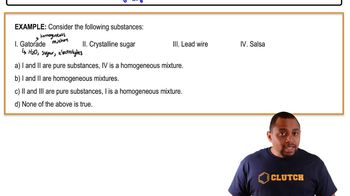
Classification of Matter Example 1

Mixture

A mixture consists of two or more substances that are physically combined but not chemically bonded. The components of a mixture retain their individual properties and can be separated by physical means. Mixtures can be homogeneous, where the composition is uniform (like saltwater), or heterogeneous, where the composition is not uniform (like a salad).
Recommended video:
Guided course
02:35
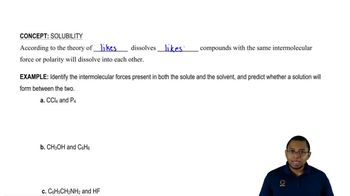
Solubility and Intermolecular Forces Concept 1

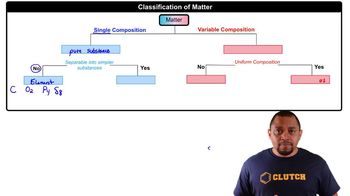
Classification of Matter

The classification of matter involves categorizing substances based on their physical and chemical properties. Matter is divided into pure substances and mixtures, with pure substances further classified into elements and compounds. Understanding this classification helps in identifying and distinguishing between different types of materials, such as determining whether ice is a pure substance or a mixture.
Recommended video:
Guided course
04:19
Classification of Matter