Pearson+ LogoPearson+ Logo
Ch.3 Matter and Energy
Timberlake - Chemistry: An Introduction to General, Organic, and Biological Chemistry 13th Edition
Timberlake13th EditionChemistry: An Introduction to General, Organic, and Biological ChemistryISBN: 9780134421353Not the one you use?Change textbook
Chapter 3, Problem 8a

Indicate whether each of the following describes a gas, a liquid, or a solid:
a. Lemonade has a definite volume but takes the shape of its container

Verified step by step guidance
1
Step 1: Understand the properties of the three states of matter: solids, liquids, and gases. Solids have a definite shape and volume, liquids have a definite volume but take the shape of their container, and gases have neither a definite shape nor a definite volume.
Step 2: Analyze the description given in the problem. The statement mentions that lemonade has a definite volume but takes the shape of its container.
Step 3: Compare the description to the properties of the three states of matter. A substance that has a definite volume but takes the shape of its container matches the properties of a liquid.
Step 4: Conclude that lemonade, as described in the problem, is in the liquid state.
Step 5: Remember that this conclusion is based on the physical properties of the substance as described, and these properties are key to identifying the state of matter.

Verified video answer for a similar problem:

This video solution was recommended by our tutors as helpful for the problem above.
Video duration:
1m
Was this helpful?

Key Concepts

Here are the essential concepts you must grasp in order to answer the question correctly.

States of Matter

Matter exists in three primary states: solid, liquid, and gas. Each state has distinct properties based on the arrangement and energy of its particles. Solids have a definite shape and volume, liquids have a definite volume but take the shape of their container, and gases have neither a definite shape nor volume.
Recommended video:
Guided course
01:35
States of Matter Concept 1

Properties of Liquids

Liquids are characterized by their ability to flow and take the shape of their container while maintaining a constant volume. This is due to the moderate intermolecular forces that allow particles to slide past one another, resulting in a fixed volume but variable shape.
Recommended video:
Guided course
04:22
Chemical Properties Concept

Intermolecular Forces

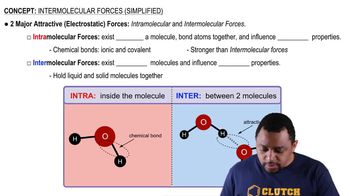
Intermolecular forces are the forces of attraction or repulsion between molecules. In liquids, these forces are strong enough to keep the molecules close together, giving them a definite volume, but not so strong as to prevent them from moving freely, allowing them to adapt to the shape of their container.
Recommended video:
Guided course
01:59
Intermolecular Forces (Simplified) Concept 1