Pearson+ LogoPearson+ Logo
Ch.17 Nucleic Acids and Protein Synthesis
Timberlake - Chemistry: An Introduction to General, Organic, and Biological Chemistry 13th Edition
Timberlake13th EditionChemistry: An Introduction to General, Organic, and Biological ChemistryISBN: 9780134421353Not the one you use?Change textbook
Chapter 17, Problem 67a

A point mutation changes a codon in the mRNA for an enzyme from GCC to GCA. Why is there no change in the amino acid order in the protein?

Verified step by step guidance
1
Understand the genetic code: The genetic code is a set of rules by which the sequence of nucleotides in mRNA is translated into a sequence of amino acids in a protein. Each group of three nucleotides (a codon) corresponds to a specific amino acid.
Identify the codons in question: The problem states that the codon changes from GCC to GCA. Both of these are codons found in the mRNA sequence.
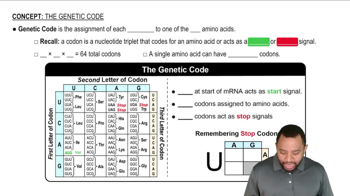
Consult the codon table: Using a codon table, determine which amino acid is encoded by GCC and GCA. Both codons encode the amino acid alanine (Ala).
Explain the concept of codon redundancy: The genetic code is redundant, meaning that multiple codons can code for the same amino acid. This redundancy is due to the wobble position (the third nucleotide in the codon), which often allows for variation without changing the amino acid.
Conclude why there is no change: Since both GCC and GCA code for alanine, the point mutation does not alter the amino acid sequence of the protein. This type of mutation is called a 'silent mutation.'

Verified video answer for a similar problem:

This video solution was recommended by our tutors as helpful for the problem above.
Video duration:
4m
Was this helpful?

Key Concepts

Here are the essential concepts you must grasp in order to answer the question correctly.

Codon Redundancy

Codon redundancy, also known as the genetic code's degeneracy, refers to the phenomenon where multiple codons can code for the same amino acid. In this case, both GCC and GCA code for the amino acid alanine, meaning that a mutation from one to the other does not alter the resulting protein's amino acid sequence.
Recommended video:
Guided course
03:25
The Genetic Code Concept 1

Point Mutation

A point mutation is a change in a single nucleotide base pair in the DNA sequence. This type of mutation can lead to different outcomes, such as silent mutations, where the amino acid remains unchanged, or missense mutations, where a different amino acid is produced. In this scenario, the point mutation is silent due to codon redundancy.
Recommended video:
Guided course
03:05
Boiling Point Elevation Concept 1

Amino Acid Sequence

The amino acid sequence of a protein is determined by the sequence of codons in the mRNA, which is transcribed from the DNA. Each codon corresponds to a specific amino acid, and the order of these amino acids dictates the protein's structure and function. Since the mutation does not change the amino acid, the sequence remains intact.
Recommended video:
Guided course
3:03
Amino Acid Catabolism: Amino Group Example 2