Pearson+ LogoPearson+ Logo
Ch.17 Nucleic Acids and Protein Synthesis
Timberlake - Chemistry: An Introduction to General, Organic, and Biological Chemistry 13th Edition
Timberlake13th EditionChemistry: An Introduction to General, Organic, and Biological ChemistryISBN: 9780134421353Not the one you use?Change textbook
Chapter 17, Problem 67b

In sickle-cell anemia, a point mutation in the mRNA for hemoglobin results in the replacement of glutamate with valine in the resulting hemoglobin molecule. Why does the replacement of one amino acid cause such a drastic change in biological function?

Verified step by step guidance
1
Understand the role of amino acids in protein structure: Amino acids are the building blocks of proteins, and their sequence determines the protein's structure and function. Even a single change in the amino acid sequence can alter the protein's properties.
Identify the chemical properties of glutamate and valine: Glutamate is a polar, negatively charged amino acid, while valine is a nonpolar, hydrophobic amino acid. This difference in chemical properties is key to understanding the impact of the mutation.
Explain the effect of the mutation on hemoglobin's structure: The replacement of glutamate with valine introduces a hydrophobic region on the surface of the hemoglobin molecule. This change disrupts the normal interactions between hemoglobin molecules.
Describe the resulting aggregation of hemoglobin molecules: The hydrophobic valine causes hemoglobin molecules to stick together, forming long, rigid fibers. These fibers distort the shape of red blood cells, giving them the characteristic sickle shape.
Connect the structural change to biological function: The sickle-shaped red blood cells are less flexible and can block blood flow in small vessels, leading to the symptoms of sickle-cell anemia, such as pain, organ damage, and reduced oxygen transport.

Verified video answer for a similar problem:

This video solution was recommended by our tutors as helpful for the problem above.
Video duration:
4m
Was this helpful?

Key Concepts

Here are the essential concepts you must grasp in order to answer the question correctly.

Point Mutation

A point mutation is a change in a single nucleotide base pair in DNA or RNA. In the case of sickle-cell anemia, this mutation alters the codon for glutamate to one that codes for valine. Such mutations can have significant effects on protein structure and function, as they may lead to the incorporation of different amino acids, which can change the protein's properties.
Recommended video:
Guided course
03:05
Boiling Point Elevation Concept 1

Protein Structure and Function

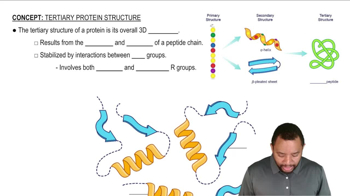
Proteins are composed of chains of amino acids that fold into specific three-dimensional shapes, which are crucial for their function. The sequence of amino acids determines how the protein folds and its overall stability. In sickle-cell anemia, the substitution of glutamate (a hydrophilic amino acid) with valine (a hydrophobic amino acid) alters the hemoglobin's structure, leading to the formation of rigid fibers that distort red blood cells.
Recommended video:
Guided course
2:07
Tertiary Protein Structure Concept 1

Biological Impact of Hemoglobin Changes

Hemoglobin is responsible for transporting oxygen in the blood. Changes in its structure due to mutations can impair its ability to bind and release oxygen effectively. In sickle-cell anemia, the altered hemoglobin (HbS) leads to sickling of red blood cells, causing blockages in blood vessels, reduced oxygen delivery, and various health complications, illustrating how a single amino acid change can have profound biological consequences.
Recommended video:
Guided course
01:53
Physical & Chemical Changes