Pearson+ LogoPearson+ Logo
Ch.13 Carbohydrates
Timberlake - Chemistry: An Introduction to General, Organic, and Biological Chemistry 13th Edition
Timberlake13th EditionChemistry: An Introduction to General, Organic, and Biological ChemistryISBN: 9780134421353Not the one you use?Change textbook
Chapter 13, Problem 38

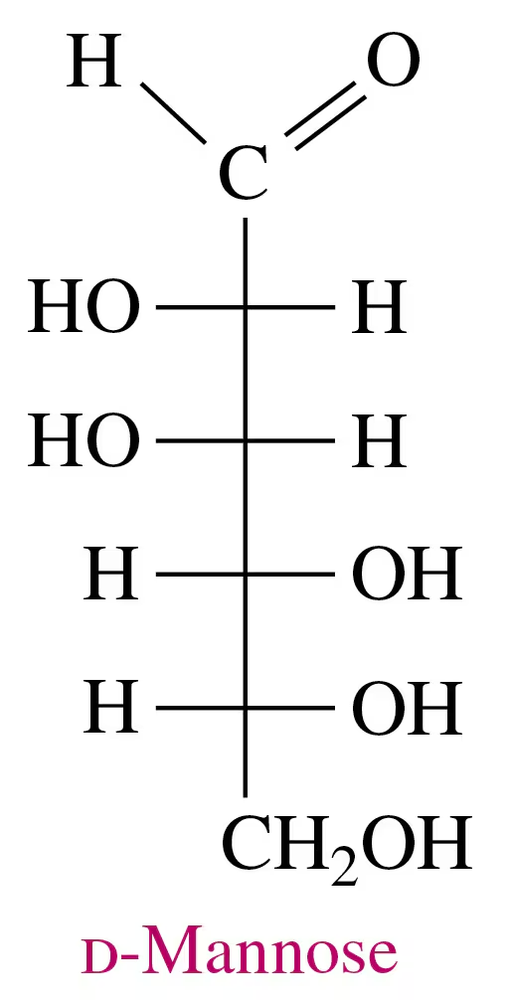
Draw the Fischer projection for the oxidation and the reduction products of D-mannose. What are the names of the sugar acid and the sugar alcohol produced?
Fischer projection of D-mannose with labels for oxidation and reduction products.

Verified step by step guidance
1
Understand the problem: D-mannose is a monosaccharide, and the problem asks for the Fischer projections of its oxidation and reduction products. Oxidation of a sugar typically produces a sugar acid, while reduction produces a sugar alcohol.
Step 1: Oxidation of D-mannose. In the oxidation process, the aldehyde group (-CHO) at the top of the Fischer projection of D-mannose is converted into a carboxylic acid group (-COOH). This results in the formation of a sugar acid. Draw the Fischer projection of D-mannose and replace the aldehyde group with a carboxylic acid group.
Step 2: Name the sugar acid. The sugar acid formed from the oxidation of D-mannose is called D-mannonic acid. This is because the aldehyde group is oxidized to a carboxylic acid, and the sugar retains the 'mann-' root of its name.
Step 3: Reduction of D-mannose. In the reduction process, the aldehyde group (-CHO) at the top of the Fischer projection of D-mannose is converted into a primary alcohol group (-CH2OH). This results in the formation of a sugar alcohol. Draw the Fischer projection of D-mannose and replace the aldehyde group with a primary alcohol group.
Step 4: Name the sugar alcohol. The sugar alcohol formed from the reduction of D-mannose is called D-mannitol. This is because the aldehyde group is reduced to an alcohol, and the sugar alcohol retains the 'mann-' root of its name with the '-itol' suffix.

Verified video answer for a similar problem:

This video solution was recommended by our tutors as helpful for the problem above.
Video duration:
2m
Was this helpful?

Key Concepts

Here are the essential concepts you must grasp in order to answer the question correctly.

Fischer Projection

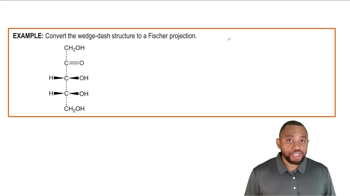
The Fischer projection is a two-dimensional representation of a molecule, particularly useful for depicting the stereochemistry of carbohydrates. In this format, the carbon chain is arranged vertically, with the most oxidized carbon at the top. Horizontal lines represent bonds that project out of the plane towards the viewer, while vertical lines represent bonds that extend behind the plane. This method is essential for visualizing the structure of sugars like D-mannose and understanding their transformations during oxidation and reduction.
Recommended video:
Guided course
0:48
Fischer Projections Example 1

Oxidation and Reduction in Carbohydrates

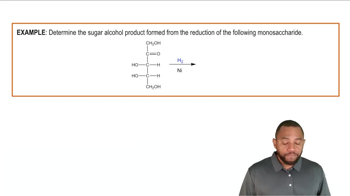
Oxidation and reduction are chemical reactions that involve the transfer of electrons. In carbohydrates, oxidation typically involves the conversion of an alcohol group (-OH) to a carbonyl group (C=O), resulting in the formation of sugar acids. Conversely, reduction involves the addition of electrons, often converting a carbonyl group back to an alcohol group, leading to the formation of sugar alcohols. Understanding these processes is crucial for identifying the products of D-mannose when subjected to oxidation and reduction.
Recommended video:
Guided course
0:55
Reduction of Monosaccharides Example 1

Sugar Acid and Sugar Alcohol

Sugar acids and sugar alcohols are specific types of carbohydrates that result from the oxidation and reduction of sugars, respectively. A sugar acid, such as D-mannonic acid, is formed when a sugar undergoes oxidation, typically resulting in a carboxylic acid functional group. In contrast, a sugar alcohol, like D-mannitol, is produced through the reduction of a sugar, where the carbonyl group is converted to an alcohol group. Recognizing these products is essential for understanding the biochemical pathways involving D-mannose.
Recommended video:
Guided course
0:39
Common Naming of Sugar Alcohols Concept 3