Pearson+ LogoPearson+ Logo
Ch.13 Carbohydrates
Timberlake - Chemistry: An Introduction to General, Organic, and Biological Chemistry 13th Edition
Timberlake13th EditionChemistry: An Introduction to General, Organic, and Biological ChemistryISBN: 9780134421353Not the one you use?Change textbook
Chapter 13, Problem 33

Draw the Haworth structures for α- and ß-D-glucose.

Verified step by step guidance
1
Understand the structure of D-glucose: D-glucose is an aldohexose, meaning it has six carbon atoms and an aldehyde group. In its cyclic form, it forms a six-membered ring (pyranose) by reacting the aldehyde group (C1) with the hydroxyl group on C5.
Determine the α- and ß-anomers: The difference between α- and ß-D-glucose lies in the orientation of the hydroxyl group attached to the anomeric carbon (C1). In the α-anomer, the hydroxyl group on C1 is trans (opposite side) to the CH2OH group on C5. In the ß-anomer, the hydroxyl group on C1 is cis (same side) to the CH2OH group on C5.
Draw the six-membered ring (pyranose): Represent the oxygen atom as part of the ring, connecting C1 to C5. Place the CH2OH group attached to C5 above the plane of the ring for D-glucose.
Add substituents to the ring: For each carbon atom (C2 to C4), place the hydroxyl groups and hydrogen atoms in the correct orientation based on the Fischer projection of D-glucose. Remember that D-glucose has the hydroxyl groups on C2 and C4 pointing to the right (down in the Haworth structure) and the hydroxyl group on C3 pointing to the left (up in the Haworth structure).
Label the α- and ß-anomers: For the α-anomer, draw the hydroxyl group on C1 pointing down (trans to CH2OH). For the ß-anomer, draw the hydroxyl group on C1 pointing up (cis to CH2OH). Ensure all other substituents remain consistent between the two structures.

Verified video answer for a similar problem:

This video solution was recommended by our tutors as helpful for the problem above.
Video duration:
7m
Was this helpful?

Key Concepts

Here are the essential concepts you must grasp in order to answer the question correctly.

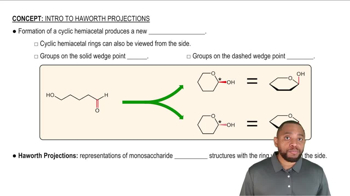
Haworth Projection

The Haworth projection is a way of representing the cyclic forms of monosaccharides, such as glucose, in a two-dimensional format. It illustrates the arrangement of atoms in a sugar molecule, showing how the carbon atoms are connected in a ring structure. This representation helps visualize the stereochemistry of the molecule, particularly the orientation of hydroxyl (–OH) groups.
Recommended video:
Guided course
2:18
Intro to Haworth Projections Concept 1

Anomeric Carbon

The anomeric carbon is the carbon atom in a sugar molecule that becomes a new chiral center when the sugar cyclizes. In D-glucose, this is the first carbon (C1) that can exist in two different configurations, leading to the formation of α- and ß-anomers. The distinction between these forms is crucial for understanding the reactivity and properties of carbohydrates.
Recommended video:
Guided course
5:36
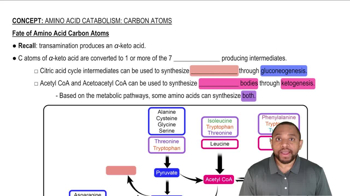
Amino Acid Catabolism: Carbon Atoms Concept 2

α- and ß-D-Glucose

α- and ß-D-glucose are two anomeric forms of D-glucose that differ in the orientation of the hydroxyl group attached to the anomeric carbon (C1). In α-D-glucose, the –OH group is positioned below the plane of the ring, while in ß-D-glucose, it is above the plane. This difference affects the physical and chemical properties of the sugars, influencing their roles in biological systems.
Recommended video:
Guided course
2:48
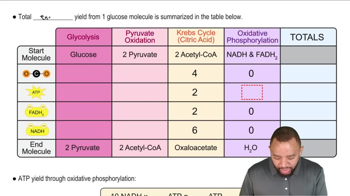
Total Energy From Glucose Concept 2