Pearson+ LogoPearson+ Logo
Ch.17 Nucleic Acids and Protein Synthesis
Timberlake - Chemistry: An Introduction to General, Organic, and Biological Chemistry 13th Edition
Timberlake13th EditionChemistry: An Introduction to General, Organic, and Biological ChemistryISBN: 9780134421353Not the one you use?Change textbook
Chapter 17, Problem 63

How is protein synthesis affected if the normal base sequence TTT in the DNA template strand is changed to TTC?

Verified step by step guidance
1
Understand the context: Protein synthesis involves transcription (DNA to mRNA) and translation (mRNA to protein). The DNA template strand is transcribed into mRNA, and the mRNA codons are translated into amino acids using the genetic code.
Identify the normal sequence: The DNA template strand has the sequence TTT. During transcription, complementary base pairing occurs, and the mRNA sequence becomes AAA (A pairs with T, and U replaces T in RNA). The codon AAA codes for the amino acid lysine.
Analyze the mutation: If the DNA template strand changes from TTT to TTC, the mRNA sequence transcribed will now be AAG (C pairs with G). The codon AAG also codes for the amino acid lysine, according to the genetic code.
Determine the effect: Since both AAA and AAG code for the same amino acid (lysine), this is an example of a silent mutation. The change in the DNA sequence does not alter the amino acid sequence of the protein.
Conclude the impact: The protein synthesis process is not affected in this case because the mutation does not change the resulting amino acid sequence. The protein's structure and function remain unchanged.

Verified video answer for a similar problem:

This video solution was recommended by our tutors as helpful for the problem above.
Video duration:
1m
Was this helpful?

Key Concepts

Here are the essential concepts you must grasp in order to answer the question correctly.

Protein Synthesis

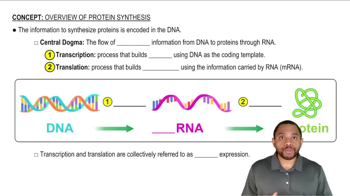
Protein synthesis is the biological process through which cells generate proteins, involving two main stages: transcription and translation. During transcription, the DNA sequence is copied into messenger RNA (mRNA), which then serves as a template for translation, where ribosomes synthesize proteins by linking amino acids in the order specified by the mRNA.
Recommended video:
Guided course
1:54
Overview of Protein Synthesis Concept 1

Codons and Amino Acids

Codons are sequences of three nucleotides in mRNA that correspond to specific amino acids or stop signals during protein synthesis. The genetic code is degenerate, meaning that multiple codons can code for the same amino acid. A change in the DNA sequence can lead to a different codon in mRNA, potentially altering the amino acid sequence of the resulting protein.
Recommended video:
Guided course
3:03
Amino Acid Catabolism: Amino Group Example 2

Mutation Effects

A mutation is a change in the DNA sequence that can affect protein synthesis. In this case, changing TTT to TTC alters the codon from coding for phenylalanine to coding for leucine. Depending on the role of the affected protein, such mutations can lead to changes in protein function, which may have various biological consequences.
Recommended video:
Guided course
04:38
Solubility: Temperature Effect Concept 1