Pearson+ LogoPearson+ Logo
Ch.17 Nucleic Acids and Protein Synthesis
Timberlake - Chemistry: An Introduction to General, Organic, and Biological Chemistry 13th Edition
Timberlake13th EditionChemistry: An Introduction to General, Organic, and Biological ChemistryISBN: 9780134421353Not the one you use?Change textbook
Chapter 17, Problem 56b

The following sequence is a portion of the DNA template strand: TGT GGG GTT ATT
b. What are the anticodons of the tRNAs?

Verified step by step guidance
1
Identify the complementary mRNA sequence that would be transcribed from the given DNA template strand. Remember that in RNA, adenine (A) pairs with uracil (U), and cytosine (C) pairs with guanine (G). For example, T in DNA pairs with A in RNA.
Write the mRNA sequence by replacing each DNA base with its complementary RNA base. For the given DNA sequence 'TGT GGG GTT ATT', the mRNA sequence will be 'ACA CCC CAA UAA'.
Divide the mRNA sequence into codons, which are groups of three nucleotides. For example, the mRNA sequence 'ACA CCC CAA UAA' would be divided into 'ACA', 'CCC', 'CAA', and 'UAA'.
Determine the anticodons of the tRNAs that would pair with the mRNA codons. Anticodons are complementary to the mRNA codons, so for each mRNA codon, replace A with U, U with A, C with G, and G with C. For example, the anticodon for the mRNA codon 'ACA' would be 'UGU'.
Write the anticodons for all the mRNA codons. For the mRNA sequence 'ACA CCC CAA UAA', the anticodons would be 'UGU', 'GGG', 'GUU', and 'AUU'.

Verified video answer for a similar problem:

This video solution was recommended by our tutors as helpful for the problem above.
Video duration:
6m
Was this helpful?

Key Concepts

Here are the essential concepts you must grasp in order to answer the question correctly.

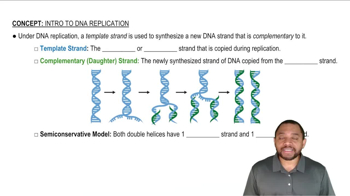
DNA Template Strand

The DNA template strand is the strand of DNA that serves as a template for RNA synthesis during transcription. It is complementary to the mRNA strand that is produced, meaning that the bases pair according to specific rules: adenine (A) pairs with uracil (U) in RNA, and cytosine (C) pairs with guanine (G). Understanding the sequence of the template strand is crucial for determining the corresponding mRNA and subsequently the anticodons.
Recommended video:
Guided course
2:20
Intro to DNA Replication Concept 1

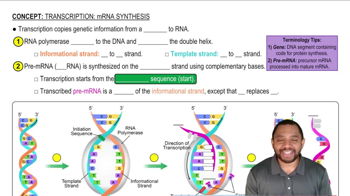
mRNA Codons

mRNA codons are sequences of three nucleotides in messenger RNA that correspond to specific amino acids or stop signals during protein synthesis. Each codon is derived from the DNA template strand and is read by the ribosome during translation. Identifying the correct codons from the mRNA is essential for determining the corresponding tRNA anticodons, which are crucial for the accurate assembly of proteins.
Recommended video:
Guided course
6:37
Transcription: mRNA Synthesis Concept 1

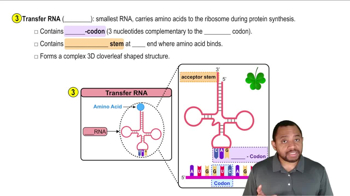
tRNA Anticodons

tRNA anticodons are sequences of three nucleotides on transfer RNA that are complementary to the mRNA codons. Each tRNA molecule carries a specific amino acid and matches its anticodon with the corresponding codon on the mRNA during translation. Understanding how to derive the anticodons from the mRNA codons is vital for grasping how proteins are synthesized in cells.
Recommended video:
Guided course
2:23
Types of RNA Concept 2