Pearson+ LogoPearson+ Logo
Ch.17 Nucleic Acids and Protein Synthesis
Timberlake - Chemistry: An Introduction to General, Organic, and Biological Chemistry 13th Edition
Timberlake13th EditionChemistry: An Introduction to General, Organic, and Biological ChemistryISBN: 9780134421353Not the one you use?Change textbook
Chapter 17, Problem 57b

The following is a segment of the DNA template that codes for human insulin: TTT GTG AAC CAA CAC CTG 
b. Write the three-letter and one-letter abbreviations for this corresponding peptide segment.

Verified step by step guidance
1
Identify the DNA template strand provided: TTT GTG AAC CAA CAC CTG.
Determine the complementary mRNA sequence by replacing each DNA base with its RNA complement: Adenine (A) pairs with Uracil (U), Thymine (T) pairs with Adenine (A), Cytosine (C) pairs with Guanine (G), and Guanine (G) pairs with Cytosine (C).
Divide the mRNA sequence into codons (groups of three nucleotides). Each codon corresponds to a specific amino acid based on the genetic code.
Use the genetic code table to translate each mRNA codon into its corresponding amino acid. Write both the three-letter and one-letter abbreviations for each amino acid.
Combine the amino acids in the order determined by the codons to form the peptide segment, listing both the three-letter and one-letter abbreviations in sequence.

Verified video answer for a similar problem:

This video solution was recommended by our tutors as helpful for the problem above.
Video duration:
5m
Was this helpful?

Key Concepts

Here are the essential concepts you must grasp in order to answer the question correctly.

DNA Codons

DNA codons are sequences of three nucleotides that correspond to specific amino acids in protein synthesis. Each codon is translated into an amino acid during the process of translation, which occurs in the ribosome. Understanding how to read these codons is essential for determining the corresponding peptide sequence.
Recommended video:
Guided course
5:08
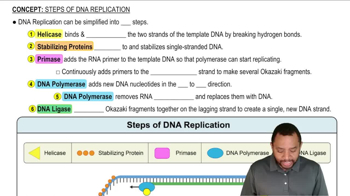
Steps of DNA Replication Concept 1

Amino Acids and Their Abbreviations

Amino acids are the building blocks of proteins, and each amino acid has a unique three-letter and one-letter abbreviation. For example, alanine is represented as 'Ala' (three-letter) and 'A' (one-letter). Knowing these abbreviations is crucial for accurately representing peptide sequences derived from DNA.
Recommended video:
Guided course
3:03
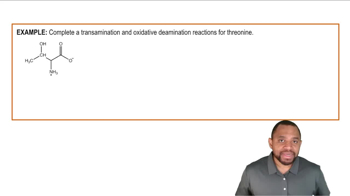
Amino Acid Catabolism: Amino Group Example 2

Translation Process

The translation process is the biological mechanism by which ribosomes synthesize proteins based on the sequence of mRNA, which is transcribed from DNA. During translation, the ribosome reads the mRNA codons and assembles the corresponding amino acids into a polypeptide chain. This process is fundamental for understanding how genetic information is expressed as functional proteins.
Recommended video:
Guided course
1:42
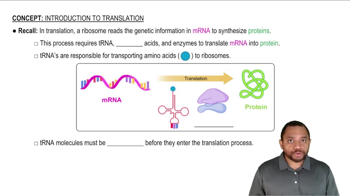
Introduction to Translation Concept 1