Pearson+ LogoPearson+ Logo
Ch.2 Chemistry and Measurements
Timberlake - Chemistry: An Introduction to General, Organic, and Biological Chemistry 13th Edition
Timberlake13th EditionChemistry: An Introduction to General, Organic, and Biological ChemistryISBN: 9780134421353Not the one you use?Change textbook
Chapter 2, Problem 27a

Perform each of the following calculations, and give an answer with the correct number of significant figures:
a. 45.7 × 0.034

Verified step by step guidance
1
Step 1: Identify the numbers involved in the calculation: 45.7 and 0.034.
Step 2: Determine the number of significant figures in each number. 45.7 has 3 significant figures, and 0.034 has 2 significant figures.
Step 3: Perform the multiplication operation: \( 45.7 \times 0.034 \).
Step 4: After performing the multiplication, round the result to the smallest number of significant figures from the numbers involved in the calculation. In this case, the result should be rounded to 2 significant figures.
Step 5: Ensure the final answer is expressed in the correct number of significant figures and includes appropriate units if applicable.

Verified video answer for a similar problem:

This video solution was recommended by our tutors as helpful for the problem above.
Video duration:
1m
Was this helpful?

Key Concepts

Here are the essential concepts you must grasp in order to answer the question correctly.

Significant Figures

Significant figures are the digits in a number that contribute to its precision. This includes all non-zero digits, any zeros between significant digits, and trailing zeros in the decimal portion. Understanding significant figures is crucial for accurately reporting measurements and calculations in scientific contexts.
Recommended video:
Guided course
01:09
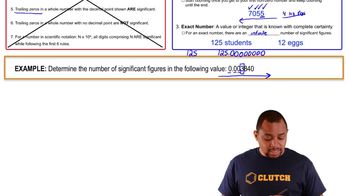
Significant Figures (Simplified) Example 2

Multiplication of Significant Figures

When multiplying numbers, the result should be reported with the same number of significant figures as the factor with the least significant figures. This rule ensures that the precision of the result reflects the least precise measurement involved in the calculation, maintaining the integrity of the data.
Recommended video:
Guided course
03:11
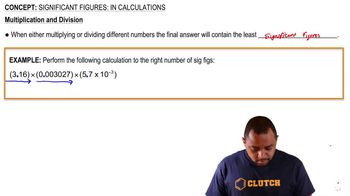
Significant Figures Calculations Concept 1

Scientific Notation

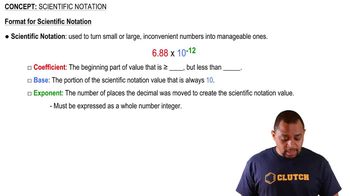
Scientific notation is a way of expressing numbers that are too large or too small to be conveniently written in decimal form. It involves writing a number as a product of a coefficient (between 1 and 10) and a power of ten. This notation is particularly useful in scientific calculations to simplify the handling of significant figures and to clearly convey the scale of the numbers involved.
Recommended video:
Guided course
01:41
Scientific Notation