Use a prefix to write the name for each of the following: c. 0.001 m
Verified step by step guidance
1
Step 1: Understand the problem. The goal is to express the given value (0.001 m) using a metric prefix. Metric prefixes are used to simplify the representation of very large or very small numbers in the metric system.
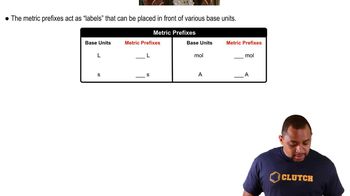
Step 2: Recall the metric prefixes and their corresponding powers of ten. For example, milli- (m) represents 10^(-3), centi- (c) represents 10^(-2), and so on.
Step 3: Identify the appropriate prefix for the given value. Since 0.001 is equivalent to 10^(-3), the correct prefix to use is 'milli-' (m).
Step 4: Combine the prefix with the base unit. In this case, the base unit is 'm' (meters), so the name becomes 'millimeter' (mm).
Step 5: Verify your work by converting back. Ensure that 1 millimeter (mm) equals 0.001 meters (m), confirming the correctness of the prefix used.
Verified video answer for a similar problem:
This video solution was recommended by our tutors as helpful for the problem above
Video duration:
2m
Play a video:
Was this helpful?
Key Concepts
Here are the essential concepts you must grasp in order to answer the question correctly.
Metric Prefixes
Metric prefixes are standardized terms used to denote specific powers of ten in the metric system. They simplify the representation of large or small quantities by providing a shorthand way to express them. For example, 'milli-' represents one-thousandth (10^-3), allowing us to express 0.001 meters as 1 millimeter (1 mm).
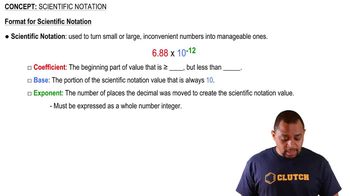
Scientific notation is a method of expressing numbers that are too large or too small in a more manageable form. It involves writing a number as a product of a coefficient and a power of ten. For instance, 0.001 can be expressed as 1 x 10^-3, which highlights its relationship to the metric prefix 'milli-'.
Unit conversion is the process of converting a quantity expressed in one unit to another unit. In this context, converting 0.001 meters to millimeters involves recognizing that 1 meter equals 1000 millimeters. Thus, multiplying 0.001 by 1000 gives us 1 mm, demonstrating the practical application of metric prefixes in everyday measurements.