Pearson+ LogoPearson+ Logo
Ch.10 Acids and Bases and Equilibrium
Timberlake - Chemistry: An Introduction to General, Organic, and Biological Chemistry 13th Edition
Timberlake13th EditionChemistry: An Introduction to General, Organic, and Biological ChemistryISBN: 9780134421353Not the one you use?Change textbook
Chapter 10, Problem 111c

One of the most acidic lakes in the United States is Little Echo Pond in the Adirondacks in New York. Recently, this lake had a pH of 4.2, well below the recommended pH of 6.5.
c. One way to raise the pH (and restore aquatic life) is to add limestone (CaCO3). How many grams of CaCO3 are needed to neutralize 1.0 kL of the acidic water from Little Echo Pond if the acid is sulfuric acid?
H2SO4(aq) + CaCO3(s) → CO2(g) + H2O(l) + CaSO4(aq)

Verified step by step guidance
1
Step 1: Understand the problem. The goal is to calculate the mass of calcium carbonate (CaCO₃) required to neutralize the sulfuric acid (H₂SO₄) in 1.0 kL of water with a pH of 4.2. Neutralization occurs via the reaction: H₂SO₄(aq) + CaCO₃(s) → CO₂(g) + H₂O(l) + CaSO₄(aq).
Step 2: Calculate the concentration of hydrogen ions [H⁺] in the water using the pH formula: \( \text{pH} = -\log[H^+] \). Rearrange to find \( [H^+] = 10^{-\text{pH}} \). Substitute \( \text{pH} = 4.2 \) to determine \( [H^+] \).
Step 3: Determine the moles of H⁺ in 1.0 kL of water. Convert the volume of water from kiloliters to liters (1.0 kL = 1000 L). Use the formula \( \text{moles of H⁺} = [H^+] \times \text{volume in liters} \).
Step 4: Use the stoichiometry of the reaction to find the moles of CaCO₃ required. From the balanced equation, 1 mole of H₂SO₄ reacts with 1 mole of CaCO₃. Since each molecule of H₂SO₄ produces 2 moles of H⁺, divide the moles of H⁺ by 2 to find the moles of CaCO₃ needed.
Step 5: Calculate the mass of CaCO₃ required. Use the molar mass of CaCO₃ (100.09 g/mol) and the formula \( \text{mass} = \text{moles} \times \text{molar mass} \). Multiply the moles of CaCO₃ by its molar mass to find the required mass in grams.

Verified video answer for a similar problem:

This video solution was recommended by our tutors as helpful for the problem above.
Video duration:
4m
Was this helpful?

Key Concepts

Here are the essential concepts you must grasp in order to answer the question correctly.

pH and Acidity

pH is a measure of the acidity or alkalinity of a solution, with lower values indicating higher acidity. A pH of 7 is neutral, while values below 7 signify acidic conditions. In the context of Little Echo Pond, a pH of 4.2 indicates significant acidity, which can harm aquatic life. Understanding pH is crucial for determining the necessary adjustments to restore a healthy ecosystem.

Neutralization Reaction

A neutralization reaction occurs when an acid reacts with a base to produce water and a salt, effectively reducing the acidity of the solution. In this case, sulfuric acid (H₂SO₄) reacts with calcium carbonate (CaCO₃) to form carbon dioxide, water, and calcium sulfate. This reaction is essential for calculating how much CaCO₃ is needed to raise the pH of the lake water.
Recommended video:
Guided course
00:37
Lewis Dot Structures: Neutral Compounds (Simplified) Concept 1

Stoichiometry

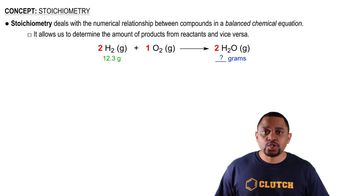
Stoichiometry is the calculation of reactants and products in chemical reactions based on balanced equations. It allows us to determine the exact amounts of substances needed for a reaction. In this scenario, stoichiometry will help calculate the grams of CaCO₃ required to neutralize the acidic water in Little Echo Pond, ensuring that the correct proportions are used to achieve the desired pH level.
Recommended video:
Guided course
01:16
Stoichiometry