Pearson+ LogoPearson+ Logo
Ch.11 Introduction to Organic Chemistry: Hydrocarbons
Timberlake - Chemistry: An Introduction to General, Organic, and Biological Chemistry 13th Edition
Timberlake13th EditionChemistry: An Introduction to General, Organic, and Biological ChemistryISBN: 9780134421353Not the one you use?Change textbook
Chapter 11, Problem 4b

Identify each of the following properties as more typical of an organic or inorganic compound:
b. is a gas at room temperature

Verified step by step guidance
1
Understand the distinction between organic and inorganic compounds: Organic compounds typically contain carbon and hydrogen atoms and are often associated with living organisms. Inorganic compounds, on the other hand, generally do not contain carbon-hydrogen bonds and are often derived from non-living sources.
Recall the physical state of organic compounds: Many organic compounds, especially small molecules like methane (CH₄) or ethane (C₂H₆), are gases at room temperature due to their relatively low molecular weights and weak intermolecular forces (e.g., London dispersion forces).
Recall the physical state of inorganic compounds: Inorganic compounds are more likely to be solids or liquids at room temperature due to their stronger ionic or covalent bonds and higher melting/boiling points. However, some inorganic compounds, like ammonia (NH₃) or carbon dioxide (CO₂), can also be gases.
Analyze the property in question: The problem specifies that the compound is a gas at room temperature. This property is more typical of small organic compounds, but it can also apply to certain inorganic compounds. Consider the context or additional information to make a more specific determination.
Conclude based on the general trend: If no additional information is provided, being a gas at room temperature is more commonly associated with small organic compounds, though exceptions exist in both categories.

Verified video answer for a similar problem:

This video solution was recommended by our tutors as helpful for the problem above.
Was this helpful?

Key Concepts

Here are the essential concepts you must grasp in order to answer the question correctly.

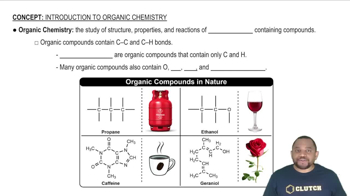
Organic Compounds

Organic compounds are primarily composed of carbon atoms and often contain hydrogen, oxygen, nitrogen, and other elements. They are typically associated with living organisms and include substances like hydrocarbons, alcohols, and sugars. Many organic compounds are volatile and can exist as gases at room temperature, especially smaller molecules.
Recommended video:
Guided course
2:26
Introduction to Organic Chemistry Concept 1

Inorganic Compounds

Inorganic compounds generally do not contain carbon-hydrogen bonds and include a wide range of substances such as minerals, metals, and salts. They can be gases, liquids, or solids at room temperature, but many inorganic gases, like carbon dioxide and ammonia, are exceptions. Understanding the distinction between organic and inorganic compounds is crucial for identifying their properties.
Recommended video:
Guided course
02:11
Naming Ionic Compounds

Physical State at Room Temperature

The physical state of a compound at room temperature (approximately 20-25°C) can indicate its molecular structure and intermolecular forces. Gases at this temperature typically have weaker intermolecular forces, allowing them to exist in a gaseous state. Recognizing whether a compound is a gas, liquid, or solid helps in classifying it as organic or inorganic based on its typical properties.
Recommended video:
Guided course
01:35
States of Matter Concept 1