Pearson+ LogoPearson+ Logo
Ch.11 Introduction to Organic Chemistry: Hydrocarbons
Timberlake - Chemistry: An Introduction to General, Organic, and Biological Chemistry 13th Edition
Timberlake13th EditionChemistry: An Introduction to General, Organic, and Biological ChemistryISBN: 9780134421353Not the one you use?Change textbook
Chapter 11, Problem 5a

Match each of the following physical and chemical properties with ethane, C2H6 or sodium bromide, NaBr:
a. boils at -89 °C

Verified step by step guidance
1
Step 1: Understand the problem. You are tasked with matching the given property (boiling point of -89 °C) to either ethane (C₂H₆) or sodium bromide (NaBr). This requires knowledge of physical and chemical properties of these substances.
Step 2: Recall the boiling points of the two substances. Ethane (C₂H₆) is a small hydrocarbon and is a nonpolar molecule. It has a low boiling point because it only exhibits weak London dispersion forces. Sodium bromide (NaBr), on the other hand, is an ionic compound with strong ionic bonds, leading to a much higher boiling point.
Step 3: Analyze the given boiling point (-89 °C). This is a very low temperature, which is characteristic of substances with weak intermolecular forces, such as nonpolar molecules like ethane.
Step 4: Match the property to the correct substance. Since -89 °C is consistent with the boiling point of ethane (C₂H₆), this property should be matched to ethane.
Step 5: Conclude that the boiling point of -89 °C is a physical property of ethane (C₂H₆), as it relates to a phase change and does not involve a chemical reaction.

Verified video answer for a similar problem:

This video solution was recommended by our tutors as helpful for the problem above.
Was this helpful?

Key Concepts

Here are the essential concepts you must grasp in order to answer the question correctly.

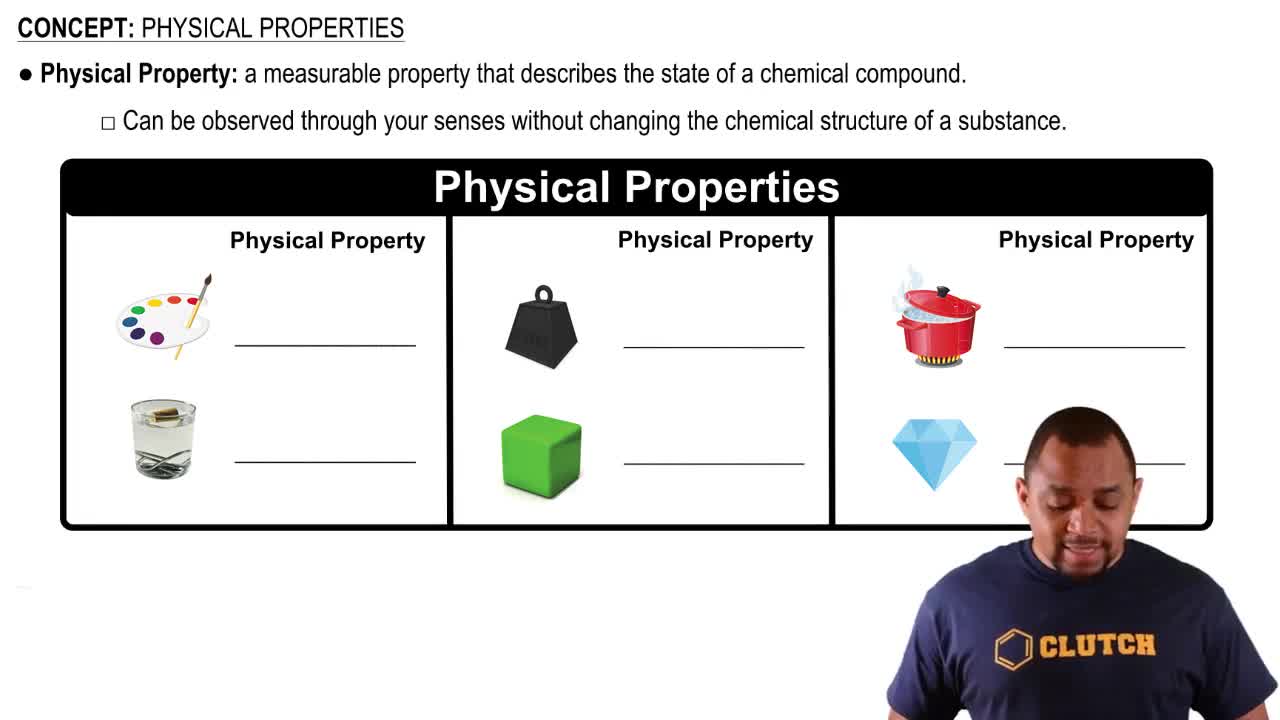
Physical Properties

Physical properties are characteristics of a substance that can be observed or measured without changing its chemical identity. Examples include boiling point, melting point, density, and color. Understanding these properties helps in identifying substances and predicting their behavior under different conditions.
Recommended video:
Guided course
02:54
Physical Properties Concept

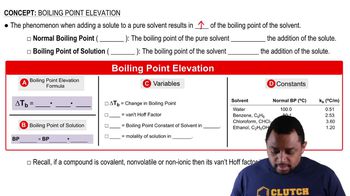
Boiling Point

The boiling point is the temperature at which a liquid's vapor pressure equals the external pressure surrounding the liquid, causing it to change into vapor. It is a critical physical property that varies between substances and can indicate molecular structure and intermolecular forces. For instance, ethane has a boiling point of -89 °C, which reflects its low molecular weight and weak van der Waals forces.
Recommended video:
Guided course
03:05
Boiling Point Elevation Concept 1

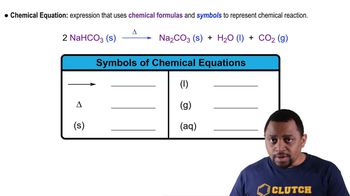
Chemical Compounds

Chemical compounds are substances formed when two or more elements chemically bond together in fixed proportions. Ethane (C₂H₆) is a hydrocarbon, while sodium bromide (NaBr) is an ionic compound. Understanding the nature of these compounds helps in predicting their physical and chemical properties, such as boiling points and solubility.
Recommended video:
Guided course
02:04
Chemical Reaction: Chemical Change Concept 2