Pearson+ LogoPearson+ Logo
Ch.11 Introduction to Organic Chemistry: Hydrocarbons
Timberlake - Chemistry: An Introduction to General, Organic, and Biological Chemistry 13th Edition
Timberlake13th EditionChemistry: An Introduction to General, Organic, and Biological ChemistryISBN: 9780134421353Not the one you use?Change textbook
Chapter 11, Problem 44b

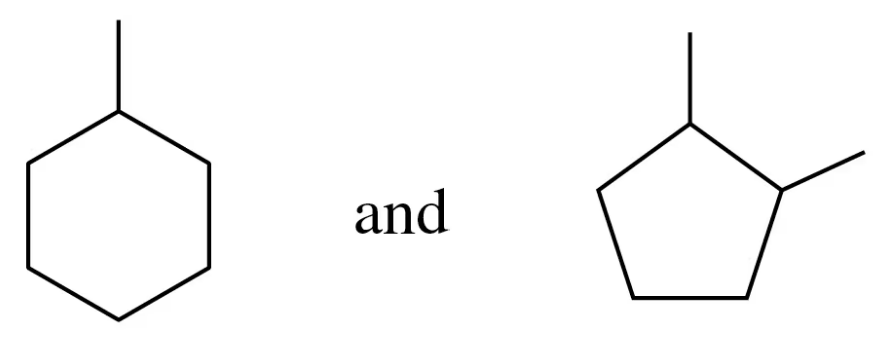
Identify the compounds in each of the following pairs as structural isomers or not structural isomers:
b. Two chemical structures side by side, labeled "and," illustrating a comparison of potential structural isomers.

Verified step by step guidance
1
Step 1: Understand the concept of structural isomers. Structural isomers are compounds that have the same molecular formula but differ in the connectivity of their atoms, resulting in different structures and properties.
Step 2: Examine the molecular formula of each compound in the pair. Verify that both compounds have the same molecular formula to confirm they are candidates for being structural isomers.
Step 3: Analyze the connectivity of atoms in each compound. Look at how the atoms are bonded to one another in each structure. Pay attention to the arrangement of functional groups, branching, and chain length.
Step 4: Compare the structures. If the connectivity of atoms differs between the two compounds, they are structural isomers. If the connectivity is identical, they are not structural isomers.
Step 5: Conclude whether the compounds are structural isomers or not based on your analysis of their molecular formula and connectivity.

Verified video answer for a similar problem:

This video solution was recommended by our tutors as helpful for the problem above.
Was this helpful?

Key Concepts

Here are the essential concepts you must grasp in order to answer the question correctly.

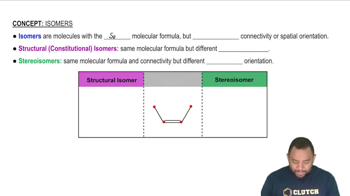
Structural Isomers

Structural isomers are compounds that have the same molecular formula but differ in the arrangement of atoms within the molecule. This can include variations in the connectivity of the atoms, leading to different structural frameworks. For example, butane and isobutane are structural isomers, as they have the same formula (C4H10) but different structures.
Recommended video:
Guided course
2:16
Isomers Concept 1

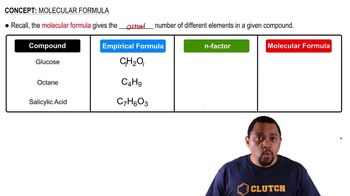
Molecular Formula

A molecular formula represents the number and types of atoms in a molecule, providing a concise way to express its composition. It does not indicate the arrangement of atoms, which is crucial for identifying isomers. For instance, both C2H6O and C2H6S have the same molecular formula but represent different compounds, highlighting the importance of structure in chemistry.
Recommended video:
Guided course
02:08
Molecular Formula

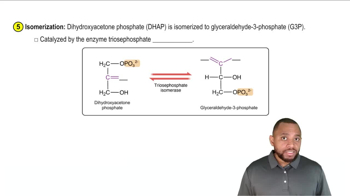
Isomerism

Isomerism refers to the phenomenon where two or more compounds have the same molecular formula but different structural or spatial arrangements. This can lead to distinct physical and chemical properties among the isomers. Understanding isomerism is essential for distinguishing between structural isomers and other types, such as stereoisomers, which differ in spatial orientation.
Recommended video:
Guided course
1:26
Glycolysis Concept 5