Pearson+ LogoPearson+ Logo
Ch.12 Alcohols, Thiols, Ethers, Aldehydes, and Ketones
Timberlake - Chemistry: An Introduction to General, Organic, and Biological Chemistry 13th Edition
Timberlake13th EditionChemistry: An Introduction to General, Organic, and Biological ChemistryISBN: 9780134421353Not the one you use?Change textbook
Chapter 12, Problem 10d

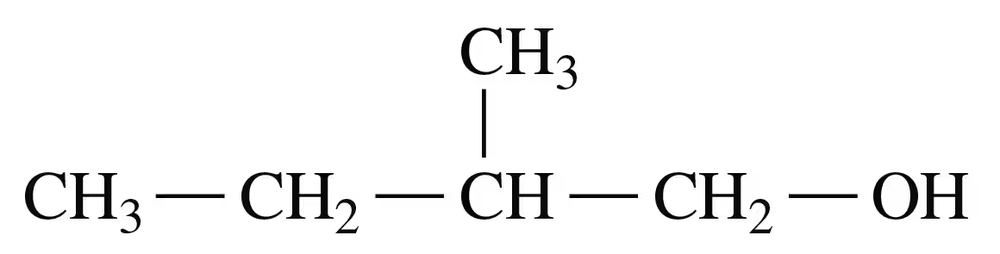
Classify each of the following alcohols as primary (1°), secondary (2°), or tertiary (3°):
d.

Verified step by step guidance
1
Step 1: Understand the classification of alcohols. Alcohols are classified based on the number of alkyl groups (R groups) attached to the carbon atom that is bonded to the hydroxyl (-OH) group. A primary (1°) alcohol has one alkyl group, a secondary (2°) alcohol has two alkyl groups, and a tertiary (3°) alcohol has three alkyl groups attached to the carbon with the -OH group.
Step 2: Examine the structure of the alcohol provided in the image. Identify the carbon atom directly bonded to the hydroxyl (-OH) group.
Step 3: Count the number of alkyl groups (R groups) attached to the carbon atom bonded to the -OH group. Remember that hydrogen atoms do not count as alkyl groups.
Step 4: Based on the number of alkyl groups, classify the alcohol. If there is one alkyl group, it is primary (1°); if there are two, it is secondary (2°); and if there are three, it is tertiary (3°).
Step 5: Confirm your classification by double-checking the structure and ensuring the correct number of alkyl groups has been identified.

Verified video answer for a similar problem:

This video solution was recommended by our tutors as helpful for the problem above.
Was this helpful?

Key Concepts

Here are the essential concepts you must grasp in order to answer the question correctly.

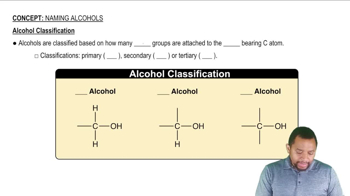
Alcohol Classification

Alcohols are classified based on the number of carbon atoms attached to the carbon atom bearing the hydroxyl (-OH) group. A primary (1°) alcohol has one carbon atom attached to the carbon with the -OH group, a secondary (2°) alcohol has two, and a tertiary (3°) alcohol has three. This classification is crucial for understanding the reactivity and properties of different alcohols.
Recommended video:
Guided course
1:10
Alcohol Classification Concept 2

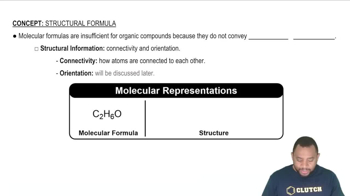
Structural Representation

Understanding the structural representation of alcohols is essential for classification. Alcohols can be depicted in various forms, such as structural formulas or skeletal formulas, which show the arrangement of atoms. Recognizing how to interpret these representations allows one to identify the type of alcohol based on its structure.
Recommended video:
Guided course
2:08
Molecular Representations Concept 1

Reactivity and Properties of Alcohols

The classification of alcohols into primary, secondary, and tertiary categories significantly influences their chemical reactivity and physical properties. For instance, primary alcohols tend to undergo oxidation more readily than tertiary alcohols. This knowledge is important for predicting the behavior of alcohols in chemical reactions and their applications in organic synthesis.
Recommended video:
Guided course
01:41
Physical Properties Example