Pearson+ LogoPearson+ Logo
Ch.12 Alcohols, Thiols, Ethers, Aldehydes, and Ketones
Timberlake - Chemistry: An Introduction to General, Organic, and Biological Chemistry 13th Edition
Timberlake13th EditionChemistry: An Introduction to General, Organic, and Biological ChemistryISBN: 9780134421353Not the one you use?Change textbook
Chapter 12, Problem 22b

Draw the condensed structural formula for each of the following:
b. 2,3-dichlorobutanal

Verified step by step guidance
1
Step 1: Understand the name of the compound. '2,3-dichlorobutanal' indicates that the compound is a butanal (a four-carbon aldehyde) with chlorine atoms attached to the second and third carbons.
Step 2: Start by drawing the backbone structure of butanal. Butanal has four carbons in a chain, with the aldehyde functional group (-CHO) attached to the first carbon.
Step 3: Add the chlorine atoms to the structure. Place one chlorine atom on the second carbon and another chlorine atom on the third carbon in the chain.
Step 4: Complete the structure by adding hydrogen atoms to satisfy the valency of each carbon atom. Remember that carbon forms four bonds, so ensure each carbon has the correct number of hydrogens after accounting for the bonds with chlorine and the aldehyde group.
Step 5: Write the condensed structural formula by grouping atoms around each carbon. For example, the aldehyde group is represented as CHO, and the chlorinated carbons are represented with their attached chlorine atoms and hydrogens.

Verified video answer for a similar problem:

This video solution was recommended by our tutors as helpful for the problem above.
Was this helpful?

Key Concepts

Here are the essential concepts you must grasp in order to answer the question correctly.

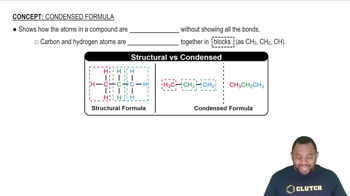
Condensed Structural Formula

A condensed structural formula is a way of representing a chemical compound that shows the arrangement of atoms and the connectivity between them without depicting all the bonds explicitly. It typically uses symbols for atoms and groups, allowing for a more compact representation. For example, in a condensed formula, carbon atoms are often listed in sequence, followed by their attached functional groups.
Recommended video:
Guided course
1:53
Condensed Formula Concept 1

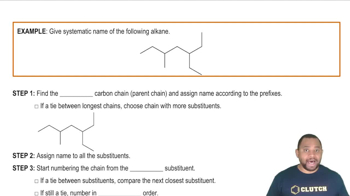
Dichloro Substitution

Dichloro substitution refers to the presence of two chlorine atoms in a compound. In the case of 2,3-dichlorobutanal, the chlorines are attached to the second and third carbon atoms of the butanal chain. This substitution affects the compound's reactivity and properties, making it important to accurately represent their positions in the structural formula.
Recommended video:
Guided course
5:07
Naming Alkanes with Substituents Example 1

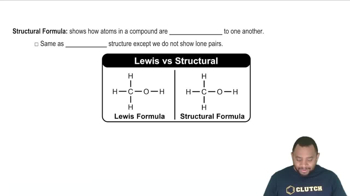
Butanal Structure

Butanal is a four-carbon aldehyde with the general formula C4H8O, characterized by a carbonyl group (C=O) at the terminal carbon. Understanding the structure of butanal is crucial for drawing its derivatives, such as 2,3-dichlorobutanal. The aldehyde functional group influences the compound's chemical behavior and is essential for identifying the correct placement of substituents in the condensed structural formula.
Recommended video:
Guided course
1:01
Structural Formula Concept 2