Pearson+ LogoPearson+ Logo
Ch.12 Alcohols, Thiols, Ethers, Aldehydes, and Ketones
Timberlake - Chemistry: An Introduction to General, Organic, and Biological Chemistry 13th Edition
Timberlake13th EditionChemistry: An Introduction to General, Organic, and Biological ChemistryISBN: 9780134421353Not the one you use?Change textbook
Chapter 12, Problem 21b

Draw the condensed structural formula for each of the following:
b. 4-chloro-2-pentanone

Verified step by step guidance
1
Step 1: Understand the name of the compound. The name '4-chloro-2-pentanone' indicates that the compound is a derivative of pentanone, a five-carbon ketone, with a chlorine atom attached to the fourth carbon and the ketone group (C=O) on the second carbon.
Step 2: Begin by drawing the backbone of the molecule, which is a chain of five carbon atoms (pentane). Label the carbons sequentially from 1 to 5.
Step 3: Add the ketone functional group (C=O) to the second carbon. This is specified by the '2-pentanone' part of the name.
Step 4: Attach a chlorine atom (Cl) to the fourth carbon as indicated by '4-chloro'. Ensure the correct placement of the chlorine atom on the fourth carbon.
Step 5: Complete the structure by adding hydrogen atoms to the remaining bonds of each carbon atom to satisfy the valency of carbon (4 bonds per carbon atom). Write the condensed structural formula by grouping atoms around each carbon.

Verified video answer for a similar problem:

This video solution was recommended by our tutors as helpful for the problem above.
Was this helpful?

Key Concepts

Here are the essential concepts you must grasp in order to answer the question correctly.

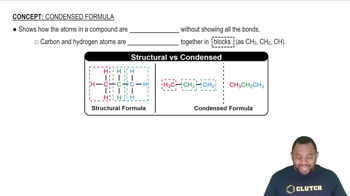
Condensed Structural Formula

A condensed structural formula is a way of representing a chemical compound that shows the arrangement of atoms and the connectivity between them without depicting all the bonds explicitly. It typically uses symbols for atoms and groups, allowing for a more compact representation. For example, in a condensed formula, carbon atoms are often grouped together with their attached hydrogens, simplifying the visualization of the molecule's structure.
Recommended video:
Guided course
1:53
Condensed Formula Concept 1

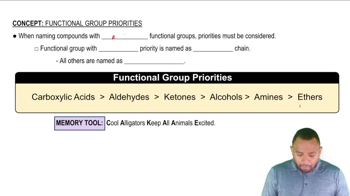
Functional Groups

Functional groups are specific groups of atoms within molecules that are responsible for the characteristic chemical reactions of those molecules. In the case of 4-chloro-2-pentanone, the ketone functional group (C=O) is present, indicating that the compound is a ketone. The presence of chlorine as a substituent at the fourth carbon also influences the compound's reactivity and properties.
Recommended video:
Guided course
1:11
Functional Group Priorities Concept 1

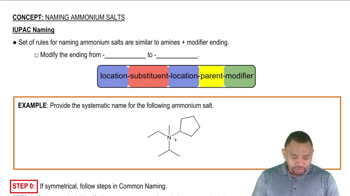
IUPAC Nomenclature

IUPAC nomenclature is a systematic method of naming chemical compounds established by the International Union of Pure and Applied Chemistry. It provides a standardized way to name compounds based on their structure, including the identification of the longest carbon chain, the position of functional groups, and the naming of substituents. Understanding IUPAC rules is essential for accurately interpreting and drawing the structures of organic compounds like 4-chloro-2-pentanone.
Recommended video:
Guided course
3:18
IUPAC Naming Concept 3