Pearson+ LogoPearson+ Logo
Ch.12 Alcohols, Thiols, Ethers, Aldehydes, and Ketones
Timberlake - Chemistry: An Introduction to General, Organic, and Biological Chemistry 13th Edition
Timberlake13th EditionChemistry: An Introduction to General, Organic, and Biological ChemistryISBN: 9780134421353Not the one you use?Change textbook
Chapter 12, Problem 21d

Draw the condensed structural formula for each of the following:
d. 3-methylpentanal

Verified step by step guidance
1
Step 1: Understand the structure of the compound. The name '3-methylpentanal' indicates that the compound is an aldehyde (due to the '-al' suffix) with a five-carbon chain (pent-) and a methyl group attached to the third carbon.
Step 2: Begin by drawing the main chain of the molecule, which is pentane (a five-carbon chain). Label the carbons as C1, C2, C3, C4, and C5.
Step 3: Add the aldehyde functional group (-CHO) to the first carbon (C1). This is because aldehydes always have the carbonyl group at the end of the chain.
Step 4: Place the methyl group (-CH₃) on the third carbon (C3) of the pentane chain. This is specified by the '3-methyl' prefix in the name.
Step 5: Write the condensed structural formula by combining all the components. The aldehyde group on C1, the methyl group on C3, and the remaining hydrogens on the other carbons should be included. Ensure the formula is compact and reflects the correct connectivity of atoms.

Verified video answer for a similar problem:

This video solution was recommended by our tutors as helpful for the problem above.
Was this helpful?

Key Concepts

Here are the essential concepts you must grasp in order to answer the question correctly.

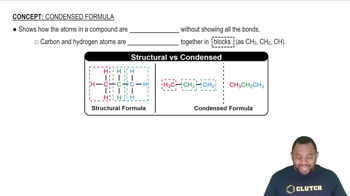
Condensed Structural Formula

A condensed structural formula is a way of representing a chemical compound that shows the arrangement of atoms and the connectivity between them without depicting all the bonds explicitly. It typically uses symbols for atoms and groups them to indicate how they are connected, making it easier to visualize the structure of organic molecules.
Recommended video:
Guided course
1:53
Condensed Formula Concept 1

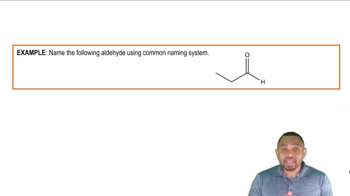
Aliphatic Aldehyde

3-methylpentanal is an aliphatic aldehyde, which means it contains a carbonyl group (C=O) at the end of a carbon chain. Aldehydes are characterized by the presence of this functional group, and their naming convention includes the suffix '-al' to indicate the aldehyde functional group, along with a prefix that denotes the length and branching of the carbon chain.
Recommended video:
Guided course
0:34
Naming Aldehydes Example 2

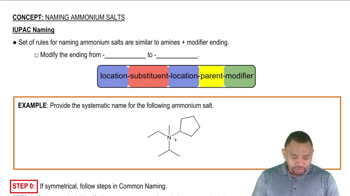
IUPAC Nomenclature

IUPAC nomenclature is a systematic method for naming chemical compounds, ensuring that each compound has a unique and descriptive name. For 3-methylpentanal, the name indicates a five-carbon chain (pent-) with a methyl group (-methyl) attached to the third carbon, and the '-al' suffix signifies the presence of the aldehyde functional group at the terminal carbon.
Recommended video:
Guided course
3:18
IUPAC Naming Concept 3