Pearson+ LogoPearson+ Logo
Ch.12 Alcohols, Thiols, Ethers, Aldehydes, and Ketones
Timberlake - Chemistry: An Introduction to General, Organic, and Biological Chemistry 13th Edition
Timberlake13th EditionChemistry: An Introduction to General, Organic, and Biological ChemistryISBN: 9780134421353Not the one you use?Change textbook
Chapter 12, Problem 63

Draw the condensed structural formulas and give the IUPAC names for all the alcohols that have the formula C5H12O.

Verified step by step guidance
1
Step 1: Understand the problem. The molecular formula C₅H₁₂O represents alcohols with five carbon atoms, twelve hydrogen atoms, and one oxygen atom. Alcohols contain a hydroxyl group (-OH) attached to a carbon atom. We need to identify all possible structural isomers and name them using IUPAC rules.
Step 2: Begin by arranging the five carbon atoms in different possible configurations. Start with a straight chain (pentane) and then consider branching (e.g., butane with a methyl group).
Step 3: Place the hydroxyl group (-OH) on different carbon atoms in each configuration. For example, in a straight-chain pentane, the -OH group can be attached to the first, second, or third carbon (positions 1, 2, and 3). For branched chains, consider all unique positions for the -OH group.
Step 4: Draw the condensed structural formulas for each isomer. For example, for 1-pentanol, the structure is CH₃CH₂CH₂CH₂CH₂OH. Repeat this for all other isomers, ensuring no duplicates.
Step 5: Assign IUPAC names to each isomer. Use the longest carbon chain containing the -OH group as the parent chain, number the chain to give the -OH group the lowest possible number, and name substituents (if any) as prefixes. For example, CH₃CH₂CH₂CH₂CH₂OH is named 1-pentanol.

Verified video answer for a similar problem:

This video solution was recommended by our tutors as helpful for the problem above.
Was this helpful?

Key Concepts

Here are the essential concepts you must grasp in order to answer the question correctly.

Alcohol Functional Group

Alcohols are organic compounds characterized by the presence of one or more hydroxyl (-OH) groups attached to a carbon atom. The position of the hydroxyl group significantly influences the properties and classification of the alcohol, such as primary, secondary, or tertiary alcohols, depending on the carbon's bonding structure.
Recommended video:
Guided course
1:41
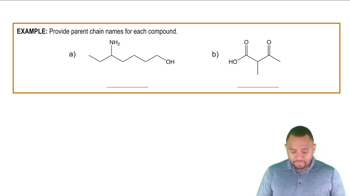
Functional Group Priorities Example 1

IUPAC Nomenclature

The International Union of Pure and Applied Chemistry (IUPAC) nomenclature provides a systematic method for naming chemical compounds. For alcohols, the name is derived from the longest carbon chain containing the hydroxyl group, with the suffix '-ol' added to the base name, and the position of the hydroxyl group indicated by a number.
Recommended video:
Guided course
3:18
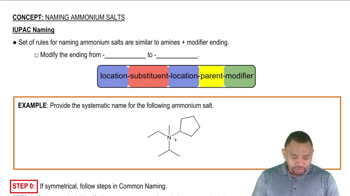
IUPAC Naming Concept 3

Structural Formula

A structural formula represents the arrangement of atoms within a molecule, showing how the atoms are bonded to each other. For alcohols, the condensed structural formula illustrates the carbon skeleton and the placement of the hydroxyl group, which is essential for understanding the compound's structure and reactivity.
Recommended video:
Guided course
1:01
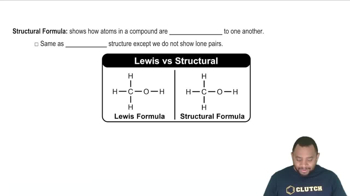
Structural Formula Concept 2