Pearson+ LogoPearson+ Logo
Ch.12 Alcohols, Thiols, Ethers, Aldehydes, and Ketones
Timberlake - Chemistry: An Introduction to General, Organic, and Biological Chemistry 13th Edition
Timberlake13th EditionChemistry: An Introduction to General, Organic, and Biological ChemistryISBN: 9780134421353Not the one you use?Change textbook
Chapter 12, Problem 62d

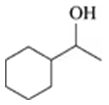
Draw the condensed structural or line-angle formula for the ketone or carboxylic acid product when each of the following is oxidized:
d.

Verified step by step guidance
1
Identify the functional group in the given compound. The structure shows a secondary alcohol (-OH group) attached to a carbon atom that is bonded to two other carbon atoms.
Understand the oxidation process for a secondary alcohol. When a secondary alcohol is oxidized, it loses two hydrogen atoms: one from the hydroxyl group (-OH) and one from the carbon atom bonded to the hydroxyl group. This forms a ketone.
Determine the product of oxidation. The hydroxyl group (-OH) will be converted into a carbonyl group (C=O), resulting in a ketone. The rest of the structure remains unchanged.
Draw the condensed structural formula or line-angle formula for the ketone. Replace the -OH group in the original structure with a C=O group to represent the ketone.
Verify the structure of the product. Ensure that the ketone product maintains the same carbon skeleton as the original compound, with the carbonyl group correctly positioned where the hydroxyl group was located.

Verified video answer for a similar problem:

This video solution was recommended by our tutors as helpful for the problem above.
Was this helpful?

Key Concepts

Here are the essential concepts you must grasp in order to answer the question correctly.

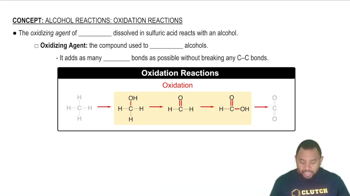
Oxidation of Alcohols

Oxidation of alcohols involves the conversion of alcohol functional groups (-OH) into carbonyl groups (C=O) or carboxylic acids (-COOH). Primary alcohols can be oxidized to aldehydes and then to carboxylic acids, while secondary alcohols are typically oxidized to ketones. Understanding the oxidation process is crucial for predicting the products formed during chemical reactions.
Recommended video:
Guided course
1:49
Alcohol Reactions: Oxidation Concept 1

Functional Groups

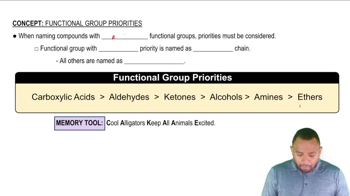
Functional groups are specific groups of atoms within molecules that are responsible for the characteristic chemical reactions of those molecules. In this context, the hydroxyl group (-OH) in alcohols and the carbonyl group (C=O) in ketones and carboxylic acids are key functional groups. Recognizing these groups helps in identifying the type of compound and its reactivity during oxidation.
Recommended video:
Guided course
1:11
Functional Group Priorities Concept 1

Condensed Structural and Line-Angle Formulas

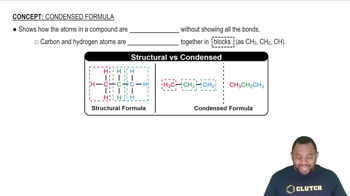
Condensed structural formulas provide a simplified representation of a molecule, showing the arrangement of atoms without depicting all bonds explicitly. Line-angle formulas, on the other hand, use lines to represent bonds and vertices to represent carbon atoms, making it easier to visualize complex structures. Mastery of these representations is essential for accurately drawing and interpreting chemical structures.
Recommended video:
Guided course
1:53
Condensed Formula Concept 1