Pearson+ LogoPearson+ Logo
Ch.13 Carbohydrates
Timberlake - Chemistry: An Introduction to General, Organic, and Biological Chemistry 13th Edition
Timberlake13th EditionChemistry: An Introduction to General, Organic, and Biological ChemistryISBN: 9780134421353Not the one you use?Change textbook
Chapter 13, Problem 27

An infant with galactosemia can utilize D-glucose in milk but not d-galactose. How does the Fischer projection of D-galactose differ from that of D-glucose?

Verified step by step guidance
1
Understand the Fischer projection: A Fischer projection is a two-dimensional representation of a molecule's three-dimensional structure, commonly used for carbohydrates. It shows the carbon chain vertically, with the most oxidized carbon (the aldehyde or ketone group) at the top.
Identify the structure of D-glucose: D-glucose is an aldohexose, meaning it has six carbons and an aldehyde group at the top. The hydroxyl (-OH) groups on carbons 2, 3, 4, and 5 are arranged as follows in the Fischer projection: on the right, left, right, and right, respectively.
Identify the structure of D-galactose: D-galactose is also an aldohexose, so it has the same number of carbons and an aldehyde group at the top. However, the arrangement of the hydroxyl (-OH) groups differs. For D-galactose, the hydroxyl groups on carbons 2, 3, 4, and 5 are arranged as follows: on the right, left, left, and right, respectively.
Compare the two structures: The key difference between D-glucose and D-galactose lies in the configuration of the hydroxyl group on carbon 4. In D-glucose, the hydroxyl group on carbon 4 is on the right, while in D-galactose, it is on the left.
Relate the difference to galactosemia: In galactosemia, the infant lacks the enzyme needed to metabolize D-galactose. This structural difference at carbon 4 prevents the enzyme from recognizing and processing D-galactose, even though it can metabolize D-glucose.

Verified video answer for a similar problem:

This video solution was recommended by our tutors as helpful for the problem above.
Video duration:
3m
Was this helpful?

Key Concepts

Here are the essential concepts you must grasp in order to answer the question correctly.

Fischer Projection

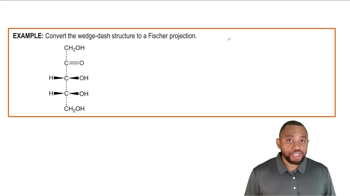
The Fischer projection is a two-dimensional representation of a three-dimensional organic molecule, particularly useful for depicting the stereochemistry of carbohydrates. In this format, the carbon chain is arranged vertically, with the most oxidized carbon at the top. The horizontal lines represent bonds that project out of the plane towards the viewer, while vertical lines represent bonds that extend behind the plane.
Recommended video:
Guided course
0:48
Fischer Projections Example 1

D-Glucose vs. D-Galactose

D-glucose and D-galactose are both six-carbon aldoses (monosaccharides) that differ in the arrangement of hydroxyl (-OH) groups around their carbon atoms. Specifically, the difference lies in the configuration at the C4 carbon; in D-glucose, the hydroxyl group is on the right, while in D-galactose, it is on the left. This structural variation leads to different biochemical properties and metabolic pathways for each sugar.
Recommended video:
Guided course
1:30
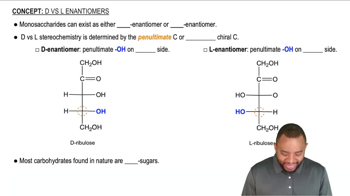
D vs L Enantiomers Concept 1

Galactosemia

Galactosemia is a genetic metabolic disorder that affects the body's ability to process galactose, a sugar found in milk. Individuals with this condition lack specific enzymes needed to convert galactose into glucose, leading to toxic accumulation of galactose in the body. Understanding this disorder is crucial for recognizing the importance of dietary management and the implications of sugar metabolism in infants.