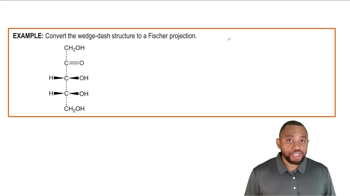
Draw the Fischer projection for the other enantiomer of a to b in problem 13.21. a. b.
Verified step by step guidance
1
Identify the Fischer projection of the given molecule (a to b) in problem 13.21. A Fischer projection is a two-dimensional representation of a molecule where horizontal lines represent bonds projecting out of the plane (toward the viewer) and vertical lines represent bonds projecting into the plane (away from the viewer).
Determine the stereochemistry of the given molecule by analyzing the configuration (R or S) of the chiral center(s). This involves assigning priorities to the substituents around the chiral center based on the Cahn-Ingold-Prelog priority rules.
To draw the enantiomer, invert the configuration of each chiral center in the molecule. This means swapping the positions of the substituents on the horizontal axis of the Fischer projection while keeping the vertical axis unchanged.
Redraw the Fischer projection with the inverted substituents. Ensure that the horizontal substituents are swapped while maintaining the vertical substituents in their original positions.
Double-check the new Fischer projection to confirm that it represents the enantiomer of the original molecule. Verify that the stereochemistry of each chiral center is opposite to that of the original molecule.
Verified video answer for a similar problem:
This video solution was recommended by our tutors as helpful for the problem above.
Video duration:
3m
Play a video:
Was this helpful?
Key Concepts
Here are the essential concepts you must grasp in order to answer the question correctly.
Fischer Projection
A Fischer projection is a two-dimensional representation of a three-dimensional organic molecule, particularly useful for depicting stereochemistry. In this format, the vertical lines represent bonds that are oriented away from the viewer, while horizontal lines represent bonds that are coming towards the viewer. This method is commonly used for carbohydrates and amino acids to illustrate their stereoisomers.
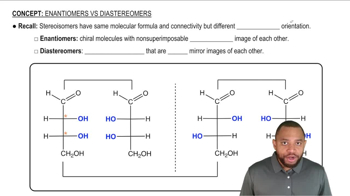
Enantiomers are a type of stereoisomer that are non-superimposable mirror images of each other. They typically arise in molecules that contain one or more chiral centers, where the arrangement of atoms around the chiral center leads to two distinct configurations. Understanding enantiomers is crucial in fields like pharmacology, as different enantiomers can have vastly different biological effects.
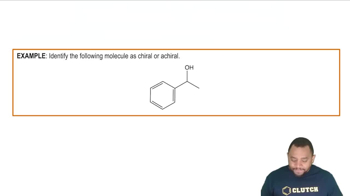
Chirality refers to the geometric property of a molecule that makes it non-superimposable on its mirror image, akin to how left and right hands are mirror images but cannot be perfectly aligned. A chiral molecule typically has at least one chiral center, often a carbon atom bonded to four different substituents. Recognizing chirality is essential for understanding the behavior of molecules in biological systems and their interactions.