
Pearson+ LogoPearson+ Logo
Ch.16 Amino Acids, Proteins, and Enzymes
Timberlake - Chemistry: An Introduction to General, Organic, and Biological Chemistry 13th Edition
Timberlake13th EditionChemistry: An Introduction to General, Organic, and Biological ChemistryISBN: 9780134421353Not the one you use?Change textbook
Chapter 16, Problem 50a

In humans, the antibiotic amoxicillin (a type of penicillin) is used to treat certain bacterial infections.
a. Does the antibiotic inhibit enzymes in humans?

Verified step by step guidance
1
Understand the role of antibiotics: Antibiotics like amoxicillin are designed to target bacterial cells, not human cells. They work by interfering with processes essential to bacterial survival, such as cell wall synthesis.
Identify the specific mechanism of amoxicillin: Amoxicillin inhibits bacterial enzymes called transpeptidases (also known as penicillin-binding proteins, PBPs). These enzymes are crucial for the synthesis of the bacterial cell wall.
Clarify the selectivity of amoxicillin: Amoxicillin is selective for bacterial enzymes because human cells do not have cell walls or the enzymes required to build them. This is why amoxicillin does not inhibit enzymes in human cells under normal circumstances.
Consider potential exceptions: While amoxicillin does not directly inhibit human enzymes, some individuals may experience side effects or allergic reactions. These are not due to enzyme inhibition but rather immune system responses or other indirect effects.
Conclude the answer: Based on the mechanism of action, amoxicillin does not inhibit enzymes in humans. Its activity is specific to bacterial enzymes involved in cell wall synthesis.

Verified video answer for a similar problem:

This video solution was recommended by our tutors as helpful for the problem above.
Video duration:
1m
Was this helpful?

Key Concepts

Here are the essential concepts you must grasp in order to answer the question correctly.

Antibiotics

Antibiotics are substances that inhibit the growth of or destroy bacteria. They work by targeting specific bacterial functions or structures, such as cell wall synthesis or protein production, without harming human cells. Understanding how antibiotics function is crucial for evaluating their effects on both bacteria and human physiology.

Mechanism of Action

The mechanism of action refers to the specific biochemical interaction through which a drug produces its pharmacological effect. For antibiotics like amoxicillin, this often involves inhibiting bacterial enzymes necessary for cell wall synthesis, leading to bacterial cell death. Recognizing this mechanism helps in understanding the selective action of antibiotics.
Recommended video:
Guided course
2:39
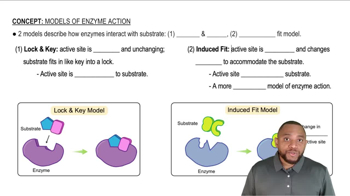
Models of Enzyme Action Concept 1

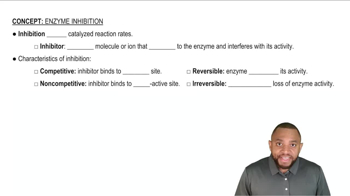
Enzyme Inhibition

Enzyme inhibition occurs when a molecule, such as an antibiotic, binds to an enzyme and decreases its activity. In the context of amoxicillin, it specifically inhibits bacterial enzymes rather than human enzymes, which is essential for its therapeutic effect. This distinction is important to understand the safety and efficacy of antibiotics in treating infections.
Recommended video:
Guided course
1:19
Enzyme Inhibition Concept 1
Related Practice
Textbook Question

Indicate whether each of the following describes a competitive or a noncompetitive enzyme inhibitor:

d. The structure of the inhibitor is not similar to the substrate.

1407
views
Textbook Question

Oxaloacetate is an inhibitor of succinate dehydrogenase. 

a. Would you expect oxaloacetate to be a competitive or a noncompetitive inhibitor? Why?

689
views
Textbook Question

Methanol and ethanol are oxidized by alcohol dehydrogenase. In methanol poisoning, ethanol is given intravenously to prevent the formation of formaldehyde that has toxic effects.

b. Would ethanol compete for the active site or bind to a different site?

867
views
Textbook Question

In humans, the antibiotic amoxicillin (a type of penicillin) is used to treat certain bacterial infections.

c. Is amoxicillin a reversible or irreversible inhibitor?

813
views
Textbook Question

Ethylene glycol (HO—CH2—CH2—OH) is a major component of antifreeze. If ingested, it is first converted to HOOC—CHO (oxoethanoic acid) and then to HOOC—COOH (oxalic acid), which is toxic.

<IMAGE>

a. What class of enzyme catalyzes the reactions described?

1125
views
Textbook Question

Ethylene glycol (HO—CH2—CH2—OH) is a major component of antifreeze. If ingested, it is first converted to HOOC—CHO (oxoethanoic acid) and then to HOOC—COOH (oxalic acid), which is toxic.

<IMAGE>

b. The treatment for the ingestion of ethylene glycol is an intravenous solution of ethanol. How might this help prevent toxic levels of oxalic acid in the body?

730
views