Pearson+ LogoPearson+ Logo
Ch.16 Amino Acids, Proteins, and Enzymes
Timberlake - Chemistry: An Introduction to General, Organic, and Biological Chemistry 13th Edition
Timberlake13th EditionChemistry: An Introduction to General, Organic, and Biological ChemistryISBN: 9780134421353Not the one you use?Change textbook
Chapter 16, Problem 48a

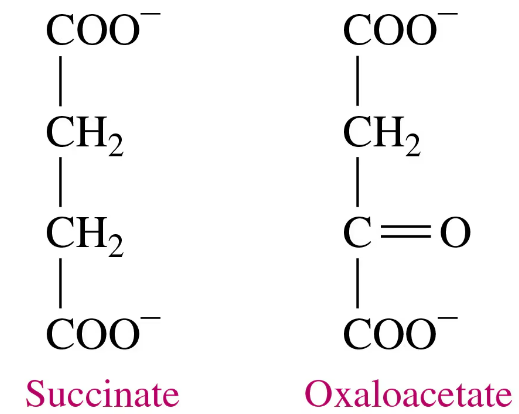
Oxaloacetate is an inhibitor of succinate dehydrogenase. 

a. Would you expect oxaloacetate to be a competitive or a noncompetitive inhibitor? Why?

Verified step by step guidance
1
Understand the difference between competitive and noncompetitive inhibition: Competitive inhibitors bind to the active site of the enzyme, competing with the substrate, while noncompetitive inhibitors bind to a different site on the enzyme, altering its function without directly competing with the substrate.
Analyze the role of oxaloacetate in the context of succinate dehydrogenase. Oxaloacetate is structurally similar to succinate, the substrate for succinate dehydrogenase, which suggests it may compete for the active site.
Consider the mechanism of inhibition: If oxaloacetate binds to the active site of succinate dehydrogenase, it would prevent succinate from binding, indicating competitive inhibition.
Evaluate whether oxaloacetate could bind elsewhere on the enzyme: If oxaloacetate binds to a site other than the active site and changes the enzyme's shape or function, it would indicate noncompetitive inhibition.
Conclude based on the evidence: Since oxaloacetate is structurally similar to succinate, it is likely a competitive inhibitor, as it competes with succinate for the active site of succinate dehydrogenase.

Verified video answer for a similar problem:

This video solution was recommended by our tutors as helpful for the problem above.
Video duration:
50s
Was this helpful?

Key Concepts

Here are the essential concepts you must grasp in order to answer the question correctly.

Competitive Inhibition

Competitive inhibition occurs when an inhibitor competes with the substrate for binding to the active site of an enzyme. In this scenario, the presence of the inhibitor can be overcome by increasing the concentration of the substrate. This type of inhibition typically results in an increase in the apparent Km (Michaelis constant) of the enzyme, while Vmax (maximum reaction velocity) remains unchanged.
Recommended video:
Guided course
1:19
Enzyme Inhibition Concept 1

Noncompetitive Inhibition

Noncompetitive inhibition happens when an inhibitor binds to an enzyme at a site other than the active site, altering the enzyme's function regardless of substrate concentration. This means that even if the substrate is present, the inhibitor can still prevent the enzyme from catalyzing the reaction effectively. In this case, the Vmax decreases, but the Km remains the same.
Recommended video:
Guided course
1:19
Enzyme Inhibition Concept 1

Oxaloacetate's Role

Oxaloacetate is a four-carbon dicarboxylic acid that plays a crucial role in the citric acid cycle. As an inhibitor of succinate dehydrogenase, it can affect the enzyme's activity by either competing with succinate for the active site or binding elsewhere. Understanding its mechanism of inhibition is essential for determining whether it acts as a competitive or noncompetitive inhibitor.
Recommended video:
Guided course
0:52
Phase C - Oxaloacetate Regeneration Example 4