Pearson+ LogoPearson+ Logo
Ch.17 Nucleic Acids and Protein Synthesis
Timberlake - Chemistry: An Introduction to General, Organic, and Biological Chemistry 13th Edition
Timberlake13th EditionChemistry: An Introduction to General, Organic, and Biological ChemistryISBN: 9780134421353Not the one you use?Change textbook
Chapter 17, Problem 21

Draw the condensed structural formula for the dinucleotide G C that would be in RNA.

Verified step by step guidance
1
Understand the structure of RNA: RNA (ribonucleic acid) is composed of nucleotides, each of which contains a ribose sugar, a phosphate group, and a nitrogenous base. The bases in RNA include adenine (A), guanine (G), cytosine (C), and uracil (U).
Identify the bases involved: The problem specifies a dinucleotide composed of guanine (G) and cytosine (C). These bases will be connected via a phosphodiester bond.
Draw the ribose sugar for each nucleotide: Each nucleotide in RNA contains a ribose sugar. Ribose is a five-carbon sugar with hydroxyl groups (-OH) attached to the 2', 3', and 5' carbons. The 1' carbon is attached to the nitrogenous base.
Attach the bases to the ribose sugars: Guanine (G) is attached to the 1' carbon of the first ribose, and cytosine (C) is attached to the 1' carbon of the second ribose. Use the correct bonding patterns for purines (G) and pyrimidines (C).
Connect the two nucleotides: Link the 3' hydroxyl group of the first ribose (G) to the 5' phosphate group of the second ribose (C) using a phosphodiester bond. This forms the backbone of the RNA dinucleotide. Write the condensed structural formula by showing the sequence G-C with the appropriate ribose and phosphate groups included.

Verified video answer for a similar problem:

This video solution was recommended by our tutors as helpful for the problem above.
Video duration:
7m
Was this helpful?

Key Concepts

Here are the essential concepts you must grasp in order to answer the question correctly.

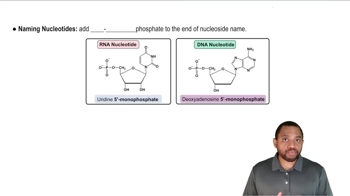
Nucleotides

Nucleotides are the building blocks of nucleic acids like RNA and DNA. Each nucleotide consists of a phosphate group, a sugar (ribose in RNA), and a nitrogenous base (adenine, guanine, cytosine, or uracil in RNA). Understanding the structure of nucleotides is essential for drawing condensed structural formulas, as it helps identify how these components connect to form larger structures.
Recommended video:
Guided course
1:21
Naming Nucleosides and Nucleotides Concept 2

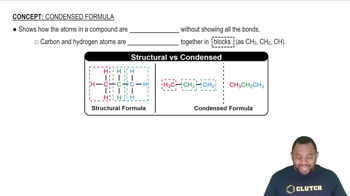
Condensed Structural Formula

A condensed structural formula is a way of representing the molecular structure of a compound in a simplified form. It shows the arrangement of atoms and the connectivity between them without depicting all the bonds explicitly. For dinucleotides, this formula will illustrate how two nucleotides are linked through a phosphodiester bond, which is crucial for understanding RNA structure.
Recommended video:
Guided course
1:53
Condensed Formula Concept 1

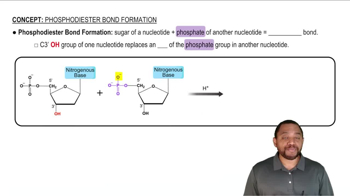
Phosphodiester Bond

A phosphodiester bond is a type of covalent bond that links the 3' carbon atom of one sugar molecule to the 5' carbon of another, forming the backbone of nucleic acids. In RNA, this bond connects nucleotides, allowing for the formation of long chains. Recognizing this bond is vital for accurately drawing the condensed structural formula of dinucleotides like GC.
Recommended video:
Guided course
2:19
Phosphodiester Bond Formation Concept 1